Unit 2 Self-Management Skills – II
Hello Dear Readers!
In this post, I seek to furnish you with study material based on the NCERT Book on Unit 2 Self Management Skills -II. It is widely known that Employability Skills are a requirement for every Skill Education course. I sincerely hope that this study material will assist you in your exam preparation and help you secure good grades in the examination.
Let us comprehend what topics you should study for Unit 2 Self Management Skills II.
Syllabus as per CBSE:

Study Material/Notes
SESSION 1. APPLY STRESS MANAGEMENT TECHNIQUES
Stress
Stress refers to a “physical, mental, or emotional strain or tension”.
Types of Stress:
- Positive Stress: If stress is taken in the right sense and may help in achieving effective outcomes, called Positive Stress.
- Negative Stress: If stress is taken in the negative sense, which makes a person worrisome, less productive and may lead to various psychosomatic disorders too, called Negative Stress.
Meaning of Stress Management
Stress Management: Stress Management refers to focusing human efforts on maintaining a healthy body and mind capable of better withstanding stressful situations. Occasional stress is an unavoidable part of one’s life. But stress over prolonged periods need to be managed.
- Managed Stress: Managed stress can help one view events and situations as challenges and contributes in the growth of an individual.
- Unmanaged Stress: Unmanaged stress leads to anxiety and sorrow resulting in ill status of mental and physical health.
Stress Causal Agents:
Stress causal agents can have the following origins.

- Mental: High expectations from the self can leave one with chronic anxiety and stress. Students can be left overwhelmed if they are unable to handle their assignment submission deadlines and examination grades.
- Physical: As children grow up, Issues related to the general well-being and health of an individual can lead to low self-esteem and cause stress.
- Social: Discord amongst family members, peer pressure for doing things that children would generally avoid, maintaining balance in relationships amongst friends, and status show-offs may lead to stress at times.
- Financial: Youngsters may have aspirational financial stress. This may be of becoming financially independent.
Importance of Stress Management
Well-versed with Stress Management, helps people lead healthy and happier life. Adequately managed stress prevents medical and physical illnesses.
Stress management is vital because it leads to the following benefits:
- Improves mood.
- Boosts immune system.
- Promotes longevity.
- Leads to burst of physical strength, which is vital for reaching goals.
- Complete mental and physical engagement for task accomplishment
- Increases efficiency and effectiveness.
- Prevents psychological disorders and behavioral problems.
Stress Management Techniques
Stress is a mental state where one size doesn’t fit all, what stresses one person may not stress others at all. It is highly individualistic phenomenon, and the solution has to be customized to individual’s mental state.
Symptoms of Stress:
- Physical Sign/Symptoms: Breathlessness, dry mouth, butterflies in stomach, indigestion, nausea, acidity, fatigue, sweaty palms, cold hands and feet, irritation, hyperactivity, etc.
- Metal Sign/Symptoms: Irritation, Impatience, loneliness, upset mood, anxiety, depression, frustration, boredom, guilt, insecurity, and forgetfulness.
Q. How self-awareness of symptoms of stress will help individuals to manage it?
Self-awareness of symptoms of stress will help individuals manage it better. They should try understanding the cause, understanding self and taking remedial measures.
Stress management techniques are:

- Physical Exercise: Physical exercise in the form of walking, skipping or for that matter indulging in any sports has been found to relieve stress as they stabilize mood, improves self-esteem, and induces sleep.
- Yoga: Yoga includes a series of postures and breathing exercises practiced to achieve control of the body and mind.
- Meditation: Meditation is a practice where an individual is supposed to focus his/her mind on a particular object, thought or activity to achieve a calm mental state reducing stress.
- Enjoying: Recreational activities like watching movies, attending concerts, playing games, involving in adventure sports, singing, dancing or even sketching can help individuals transcend to a happier mental state and help manage stress.
- Going on Vacation: Vacations provide an opportunity of taking a holiday from our routine and appreciate different facets of life.
- Taking Nature Walks: Taking nature walks in a pristine environment of a national park or a sanctuary or a trail in the countryside/village, brings us calmness by allowing our overstimulated minds a chance to relax and helps us to relax.
SESSION 2. DEMONSTRATE THE ABILITY TO WORK INDEPENDENTLY
Work Independently:
Work independently means one must learn to take ownership of the task assigned and leave no stone unturned in accomplishing the task.
Self-Reliance:
The individual, who has the ability to work independently called Self-Reliance.
Importance of The Ability to Work Independently / Benefits of the Ability to Work Independently
Following benefits of working independently advocate its importance.
- Ensures greater learning.
- Individuals feel more empowered and responsible.
- It provides flexibility to choose and define working hours and working mechanisms.
- Failure and success of the task assigned are accounted by individuals.
- Individuals become assets to organizations, groups and nations at large.
- It ensures creativity and satisfaction amongst individuals.
Self-Awareness:
Having conscious knowledge of your own self, capabilities, feelings and one’s own character is called as self-awareness.
- It helps individuals to chart their ways for working independently.
- They become aware of their strengths and weak points and work accordingly.
- They try to focus on strengths to become successful in various arenas of life.
Self-awareness will help you in converting your weakness into strength and strengths into an exceptional talent.
Knowing Yourself:
Understanding who you are, what you like or dislike, what are your beliefs, what are your opinions, what is your background, what you do well and what you do not do well is important because only then can you measure your strengths and weaknesses.
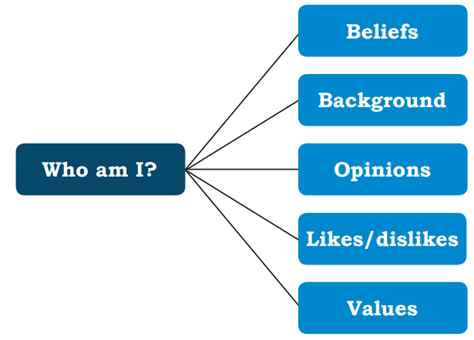
In other words, being self-aware actually means knowing your inner strengths, hidden talents, skills and even weaknesses.
Q. How we define strengths and weaknesses?

Difference between Interests and Abilities (Strengths):
| Interest | Abilities |
| Things that you like to do in your free time that make you happy. | An acquired or natural capacity |
| Things you are curious about or would do even if no one asked you to do it. | Enable you to perform a particular job or task with considerable proficiency. |
| Things you want to learn or would like to do in the future. |
Types of Self-Awareness:
There are two types of self-awareness: private and public.
- Private self-awareness is when people are aware of something about themselves that others might not be — like being anxious about reading out loud.
- Public self-awareness is when people are aware of how others see them.
Self-Motivation
Self-motivated individuals have an inner urge to do something, achieve their goals without any external pressure/lure for award or appreciation.
- It is a life skill and must be necessarily developed.
- Self-motivation is what pushes us to achieve our goals, feel happy and improve our quality of life.
- It is our ability to do the things that need to be done without someone or something influencing us.
Types of Motivation
- Internal Motivation: LOVE
We do things because they make us happy, healthy and feel good. For example, when you perform on your annual day function and you learn something new, such as dancing, singing, etc., you feel good.
- External Motivation: REWARD
We do things because they give us respect, recognition, and appreciation. For example, Suresh participated in a 100m race and won a prize. This motivated him to go for practice every morning.
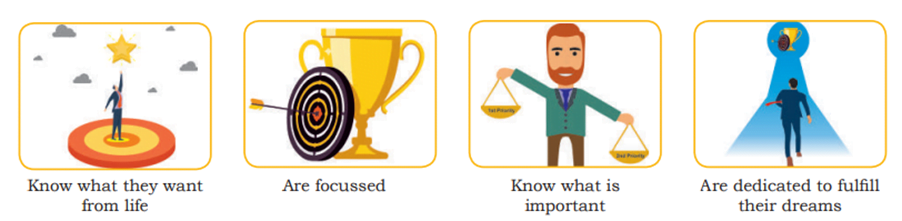
Qualities of Self-motivated People
- Know what they want from life.
- Are focused.
- Know what is important.
- Are dedicated to fulfill their dreams.
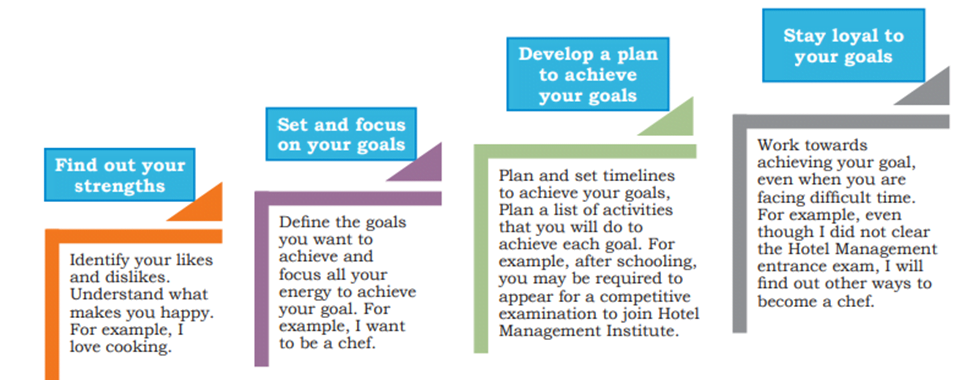
Building Self-motivation
There are four steps for building self-motivation, which are as given below.
- Find out your strengths.
- Set and focus on your goals.
- Develop a plan to achieve your goals.
- Stay loyal to your goals.
Self-Regulation
Self-regulation guides independent individuals as it helps them consider long term consequences rather than just transient feelings.
- It leads to a responsible and a value driven behaviour.
- It teaches self – control and well directed efforts to reach goal.
- Self – regulation inculcates discipline that helps in consistent efforts to move towards goal.
Goals: They are a set of dreams with a deadline to get them, for example, saving pocket money to buy a favourite mobile phone by a particular date.
- Goals allow you to separate out what’s important.
- It helps you to focus on the end result instead of less important work. This will make you successful in your career and personal life.
Goal setting: It is all about finding and listing your goals and then planning on how to achieve them.
A SMART method to set goals:
SMART stands for Specific, Measurable, Achievable, Realistic and Time bound.
- Specific: A specific goal gives the proper direction.
- Measurable: Goal must be measurable.
- Achievable: Breaking down big goals into smaller parts will make the goal achievable
- Realistic: A realistic goal would be something that we want to achieve and can work towards.
- Time bound: A SMART goal should have a timeframe by when the goal needs to be achieved.
By Anjeev Kr Singh – Computer Science Educator
Published on : June 18, 2023 | Updated on : September 23, 2026
About the Author