Class 10 AI Unit 3 Evaluating Models – Accuracy and Errors Notes with worksheet
Accuracy and Error Method
(What is Accuracy and Error?)
To evaluate how well an AI or Machine Learning model performs, we use evaluation metrics. Two important metrics are Accuracy and Error. These help us understand how close the model’s predictions are to real or actual values.
Example to Understand Accuracy and Error
Bob and Billy went to a concert.
- Bob guessed the entry fee to be ₹300
- Billy guessed the entry fee to be ₹550
- The actual entry fee was ₹500
To evaluate their guesses, we need to find:
- Who gave a more accurate estimate?
- What is the error in their estimates compared to the actual fee?
Bob’s error = |500 − 300| = 200
Billy’s error = |500 − 550| = 50
Since Billy’s error is smaller, Billy’s estimate is more accurate.
What is Accuracy?
Accuracy is an evaluation metric that measures how many predictions made by a model are correct.
In Machine Learning, higher accuracy generally indicates better model performance. A model that makes more correct predictions is considered more accurate.
Accuracy and model performance are directly proportional:
- Higher accuracy → Better performance
- Lower accuracy → Poorer performance
What is an Error?
Error refers to the difference between a model’s predicted value and the actual value.
In Machine Learning, error helps us understand:
- How far the prediction is from the real outcome
- How well the model can predict unseen or new data
Error is used to compare different models and select the one that performs best for a given dataset.
- Based on our error, we choose the machine learning model that performs best for a particular dataset.
Error refers to the difference between a model’s prediction and the actual outcome. It quantifies how often the model makes mistakes.
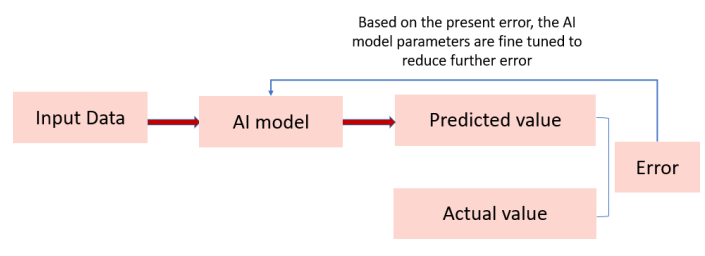
Example: Classification Task – Imagine you’re training a model to predict if you have a certain disease
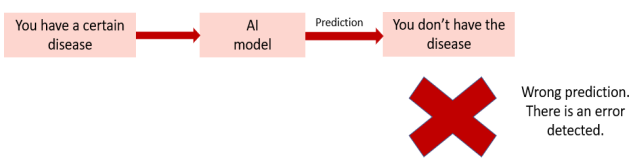
- 👉Error: If the model predicts you don’t have a disease but you actually have a disease, that’s an error. The error quantifies how far off the prediction was from reality.
- 👉Accuracy: If the model correctly predicts disease or no disease for a particular period, it has 100% accuracy for that period.
Summary: Key Points of Accuracy and Error Method:
- The goal is to minimize error and maximize accuracy.
- Real-world data can be messy, and even the best models make mistakes.
- Sometimes, focusing solely on accuracy might not be ideal. For instance, in medical diagnosis, a model with slightly lower accuracy but a strong focus on avoiding incorrectly identifying a healthy person as sick might be preferable.
- Choosing the right error or accuracy metric depends on the specific task and its requirements.
Understanding both error and accuracy is crucial for effectively evaluating and improving AI models.
Activity 1: Find the accuracy of the AI model
Que: Calculate the accuracy of the House Price prediction AI model
- Read the instructions and fill in the blank cells in the table.
- The formula for finding error and accuracy is shown in the table.
- Accuracy of the AI model is the mean accuracy of all five samples.
- Percentage accuracy can be seen by multiplying the accuracy with 100.
Note: Abs means the absolute value, which means only the magnitude of the difference without any negative sign (if any)
| Predicted House Price (USD) | Actual House Price (USD) | Error Abs (Actual – Predicted) | Error Rate (Error / Actual) | Accuracy ( 1 – Error rate) | Accuracy% (Accuracy * 100)% |
| 391k | 402k | Abs (402k-391k) = 11k | 11k/402k = 0.027 | 1-0.027 = 0.973 | 0.973*100% = 97.3% |
| 453k | 488k | ||||
| 125k | 97k | ||||
| 871k | 907k | ||||
| 322k | 425k |
Solution:
| Predicted House Price (USD) | Actual House Price (USD) | Error Abs (Actual – Predicted) | Error Rate (Error / Actual) | Accuracy (1-Error rate) | Accuracy% (Accuracy*100)% |
| 391k | 402k | Abs (402k-391k) = 11k | 11k/402k = 0.027 | 1- 0.027 = 0.973 | 0.973*100% = 97.3% |
| 453k | 488k | 35k | 0.072 | 0.928 | 92.8% |
| 125k | 97k | 28k | 0.289 | 0.711 | 71.1% |
| 871k | 907k | 36k | 0.040 | 0.96 | 96.0% |
| 322k | 425k | 103k | 0.242 | 0.758 | 75.8% |
Accuracy = (0.973 + 0.928 + 0.711 + 0.96 + 0.758) / 5 = 0.866
Accuracy % = 86.6%
Unit 3 Evaluating Models – Accuracy and Errors – Worksheets
Section A: Multiple Choice Questions (10)
- Accuracy in AI models refers to
A) Total predictions made
B) Total errors made
C) Number of correct predictions
D) Difference between actual and predicted values
Answer: C - Error in machine learning is best described as
A) Wrong dataset
B) Difference between predicted and actual outcome
C) Number of predictions
D) Training data size
Answer: B - A smaller error value indicates
A) Lower accuracy
B) Poor performance
C) Better prediction
D) More randomness
Answer: C - Accuracy and model performance are
A) Inversely proportional
B) Unrelated
C) Directly proportional
D) Random
Answer: C - The absolute value is used while calculating error because
A) It increases accuracy
B) It removes negative signs
C) It changes predictions
D) It modifies data
Answer: B - Which metric should be minimized for better model performance?
A) Accuracy
B) Error
C) Dataset size
D) Prediction count
Answer: B - If an AI model predicts correctly every time, its accuracy is
A) 0%
B) 50%
C) 75%
D) 100%
Answer: D - Error Rate is calculated as
A) Actual ÷ Predicted
B) Predicted ÷ Actual
C) Error ÷ Actual
D) Error ÷ Predicted
Answer: C - In medical diagnosis, which is more critical?
A) Only high accuracy
B) Ignoring error
C) Minimizing critical errors
D) Random prediction
Answer: C - Accuracy percentage is calculated by
A) Dividing accuracy by 100
B) Adding error rate to accuracy
C) Multiplying accuracy by 100
D) Subtracting accuracy from 1
Answer: C
Section B: Assertion–Reason Questions (3)
- Assertion: Accuracy measures how many predictions are correct.
Reason: Accuracy is calculated using error rate.
Answer: Both A and R are true, but R is not the correct explanation of A. - Assertion: Error helps in selecting the best-performing AI model.
Reason: Error shows the difference between predicted and actual values.
Answer: Both A and R are true, and R is the correct explanation of A. - Assertion: A model with higher accuracy always performs better in all real-world situations.
Reason: In critical applications, minimizing specific errors is more important.
Answer: A is false, R is true.
Section C: Fill in the Blanks (5)
- Accuracy measures the number of __________ predictions made by a model.
Answer: correct - Error is the difference between __________ and __________ values.
Answer: predicted, actual - The main goal of an AI model is to maximize accuracy and minimize __________.
Answer: error - Absolute value considers only the __________ of the difference.
Answer: magnitude - Accuracy percentage is obtained by multiplying accuracy by __________.
Answer: 100
Section D: Short Answer Questions (30 words)
- What is accuracy in machine learning?
Answer: Accuracy is an evaluation metric that measures how many predictions made by an AI model are correct compared to the total number of predictions. - Define error in AI models.
Answer: Error refers to the difference between the predicted value produced by the model and the actual value obtained in reality. - Why is absolute value used in error calculation?
Answer: Absolute value is used to remove negative signs and measure only the magnitude of the difference between predicted and actual values. - How are accuracy and model performance related?
Answer: Accuracy and model performance are directly proportional. Higher accuracy generally indicates better model performance and reliable predictions. - Why may accuracy alone be misleading in medical diagnosis?
Answer: In medical diagnosis, certain errors can be critical. A model with slightly lower accuracy but fewer dangerous errors may be more reliable.
Section E: Long Answer Questions (80 words)
- Explain accuracy and error as evaluation metrics in AI models.
Answer:
Accuracy and error are important evaluation metrics used to assess the performance of AI models. Accuracy measures the proportion of correct predictions made by a model, indicating how reliable the model is. Error represents the difference between the predicted value and the actual outcome, helping us understand how far the prediction deviates from reality. The goal of model evaluation is to maximize accuracy while minimizing error. Both metrics together provide a complete understanding of model performance. - Why is it important to analyze both accuracy and error while evaluating an AI model?
Answer:
Analyzing both accuracy and error is important because accuracy alone does not reveal the nature of mistakes made by the model. Error helps in identifying how severe or frequent the incorrect predictions are. In real-world applications like healthcare or finance, certain errors can have serious consequences. Therefore, a model with slightly lower accuracy but fewer critical errors may be more suitable. Understanding both metrics ensures effective and responsible AI model evaluation.
Section F: Competency-Based Questions (CBQs)
- A house price prediction model shows high accuracy but large errors for expensive houses. What should be improved?
Answer: The model’s error handling should be improved by focusing on reducing error for high-value predictions instead of relying only on overall accuracy. - Two AI models have similar accuracy values, but one has a lower average error. Which model should be preferred and why?
Answer: The model with lower average error should be preferred because its predictions are closer to actual values, making it more reliable. - A medical AI system avoids diagnosing healthy people as sick but sometimes misses actual patients. What evaluation focus is required?
Answer: The system should focus on minimizing critical errors rather than only improving overall accuracy to ensure patient safety.
By Anjeev Kr Singh – Computer Science Educator
Published on : February 8, 2026 | Updated on : February 8, 2026
About the Author