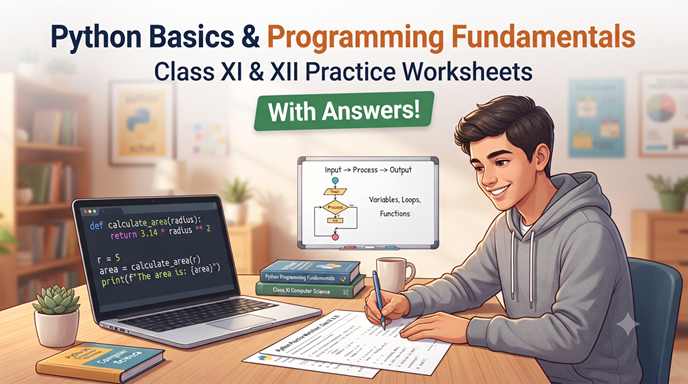
Python Basics & Programming Fundamentals: Class XI & XII Practice Worksheets (With Answers)
Worksheet Set 1: Introduction, Features & Execution Modes
COMPUTER SCIENCE / INFORMATICS PRACTICES
Worksheet Set 1: Introduction, Features & Execution Modes
Q1. What is Python? Who developed it and in which year was it released?
Q2. State any three prominent features of the Python programming language.
Q3. Write a simple Python statement to print “Hello World” on the screen.
Q4. Differentiate between Interactive mode and Script mode in Python.
Q5. What is the primary prompt symbol used in Python’s interactive mode?
Q6. What is the file extension used to save Python script files?
Q7. Is Python case-sensitive? Explain with an example why variable names like Age and age differ.
Q8. Why is Python often referred to as an interpreted language?
Q9. Can a Python script written in script mode be executed directly from the command line or terminal? Name the command tool.
Q10. State whether Python code execution requires manual compilation before running. Justify your answer.
Worksheet Set 2: Character Set & Tokens (Keywords, Identifiers, Literals, Operators, Punctuators)
COMPUTER SCIENCE / INFORMATICS PRACTICES
Worksheet Set 2: Python Character Set & Tokens
Q1. What is a Python token? Name the five types of tokens available in Python.
Q2. What are keywords? Can keywords be used as variable names in Python? Give a reason.
Q3. Define an identifier. State two rules for naming valid identifiers in Python.
Q4. Identify which of the following are valid identifiers in Python: 1st_var, _total, for, my-var, emp_salary.
Q5. What are literals in Python? List out four different types of literals supported.
Q6. Classify the following operators into arithmetic, relational, and logical: +, and, >=, %, not, ==.
Q7. What are punctuators? Give three examples of punctuators used in Python.
Q8. What is the Python character set?
Q9. Differentiate between integer literals and floating-point literals with examples.
Q10. How many tokens are present in the following Python statement? sum = x + 10
Worksheet Set 3: Variables, l-values, r-values & Comments
COMPUTER SCIENCE / INFORMATICS PRACTICES
Worksheet Set 3: Variables, l-values, r-values & Comments
Q1. What is a variable in Python? How is it created?
Q2. Explain the concept of an l-value and an r-value in an assignment statement.
Q3. In the statement score = 95, identify which component acts as the l-value and which acts as the r-value.
Q4. Can a constant value or expression be placed on the left side of an assignment operator? Give a reason.
Q5. What are comments in Python? Why are they used?
Q6. How do you write single-line comments and multi-line comments in Python?
Q7. Does the Python interpreter execute comment lines? Justify your answer.
Q8. What will be the output of the following code snippet? # print("Hello")
Q9. Explain how Python handles variable declaration dynamically without explicit data type declarations.
Q10. Evaluate the assignment statement x = x + 1. Is x acting as an l-value, an r-value, or both? Explain.
By Anjeev Kr Singh – Computer Science Educator
Published on : September 19, 2026 | Updated on : September 19, 2026
About the Author