Class 10 Self Management Skills Notes, MCQs and Question Answers
Self Management Skills Class 10 Notes
What is Self-Management?
Self-management, also referred to as ‘self-control,’ is the ability to control one’s emotions, thoughts and behavior effectively in different situations. This also includes motivating oneself and setting goals.
Basics of Self-management
To do better at work and life you must be able to manage and improve yourself in various skills including discipline and timeliness, goal setting, problem solving, teamwork, professionalism, etc. Once you develop your personality and abilities you will be able to succeed in personal as well as professional life.

Some of the skills you must master to succeed in life
- Self-awareness – Ask for honest feedback. Think about your daily interactions and how you handled situations well or could have handled them differently.
- Responsibility – Taking responsibility for your tasks is very important. Taking ownership is the step towards self-development.
- Time Management – Priorities the things you have to do. Remove waste and redundancy from work. Make a timetable and follow it diligently.
- Adaptability – Stay current with best practices and read up on new information always. Prepare yourself for new changes, so that you can transition seamlessly.
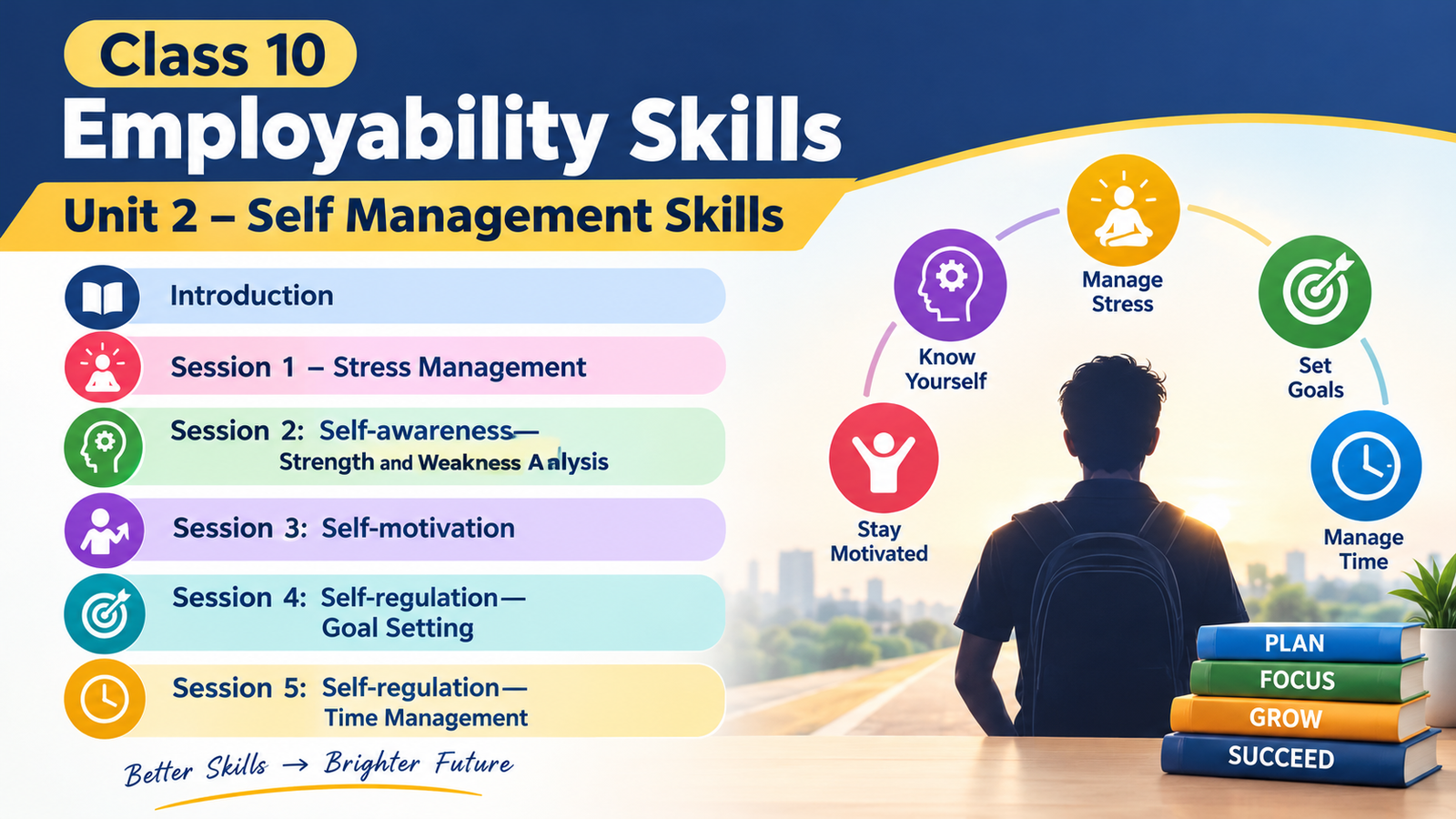
Session 1: Stress Management
 What is Stress?
Stress can be defined as our emotional, mental, physical and social reaction to any perceived demands or threats. These demands or threats are called stressors. Stressors are the reason for stress.
For example,
- You are too close to the exams but feel unprepared.
- You are experiencing a loss of someone close in the family.
- You are worried about what people would think of you if you don’t dress well or cannot speak confidently.
- You are stressed due to lack of sleep.
Stress Management
Stress is Helpful:
Stress is a part of everyday life. There are many instances when stress can be helpful. For example:
- A fire alarm is intended to cause stress that alerts you to avoid danger.
- The stress created by a deadline to finish a paper can motivate you to finish the assignment on time.
Stress is Harmful:
When you experience stress in excess or for a long period of time, stress becomes harmful.
- It can harm our emotional and physical health, and limit our ability to function well at home, in school and within our relationships.
Stress Management:
Managing stress is about making a plan to be able to cope effectively with daily pressures. The ultimate goal is to strike a balance between life, work, relationships, relaxation and fun.
ABC of Stress Management:
Always keep in mind the ABC of Stress Management
A: Adversity or the stressful event
B: Beliefs or the way you respond to the event
C: Consequences of actions and outcomes of the event
Benefits of Stress Management
Stress management can help you to
- have a joyful life.
- focus and complete tasks on time.
- be a happy person as you are stress free.
- be more energetic and spend quality time with your friends and family.
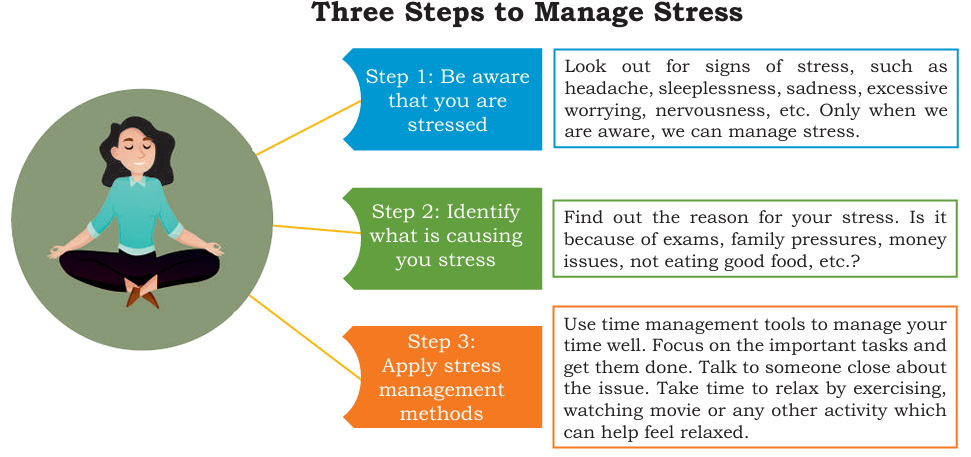
Three Steps to Manage Stress
Different Stress Management Techniques
Here are a few simple stress management techniques.
- Time Management: Proper time management is one of the most effective stress-relieving techniques.
- Exercise and Fresh Air: A healthy lifestyle is essential for students. Stress is generally lower in people who maintain a healthy routine. Doing yoga, meditation and deep breathing exercises help in proper blood circulation and relaxes the body.
- Healthy Diet: Having a healthy diet or balanced diet will also help you reduce stress.
- Positivity: Focussing on negative aspects of life will add more stress. Instead, learn to look at the good things and stay positive.
- Organising academic life; no delaying: By keeping class notes organised, finishing in assignments on time, and keeping track of all deadlines, stress can be reduced to a great extent.
- Adequate Sleep: We should get a good night’s sleep for at least 7 hours so that your brain and body gets recharged to function better the next day.
- Holidays with family and friends: Going to a relative’s place, such as your grandparents’ house or a new place during your summer vacations can help you break from the normal routine and come back afresh.
Ability to Work Independently
If you can become a calm and relaxed person, you will have the ability to work independently, which means.
- Becoming self-aware, self-monitoring and self-correcting.
- Knowing what you need to do.
- Taking the initiative rather than being told what to do.
- Recognising your mistakes and not blaming others.
- Having the ability and the will to learn continuously.
Emotional Intelligence
Emotional intelligence is the ability to identify and manage one’s own emotions, as well as the emotions of others. This usually includes three key skills –
- Emotional Awareness: The ability to identify and name one’s own emotions.
- Harnessing Emotions: The ability to harness and apply emotions to tasks like thinking and problem solving.
- Managing Emotions: The ability to regulate one’s own emotions when necessary and help others to do the same.
Some steps to manage emotional intelligence are as given below –
- Understand your emotions: Observe your behavior and note the things you need to work on. You can then work on the things you need to improve.
- Rationalise: Do not take decisions abruptly; be rational in your thinking.
- Practice: Do meditation and yoga to keep yourself calm.
Session 2: Self-awareness— Strength and Weakness Analysis
Techniques for Identifying your Strengths and Weaknesses
Finding Strengths (or abilities)
- Think of anything that you are always successful at.
- Think about what others like in you.
- Take out time and think about what you do well.
Finding Weaknesses
- Point out the areas where you struggle and the things you find difficult to do.
- Look at the feedback others usually give you.
- Be open to feedback and accept your weaknesses without feeling low about it. Take it as an area of improvement.
Difference between Interests and Abilities (Strengths)
| Interest | Abilities |
| Things that you like to do in your free time that make you happy. | An acquired or natural capacity. |
| Things you are curious about or would de enve if no one asked you to do it. | Enable you to perform a particular job or task with considerable proficiency. |
| Things you want to learn or would like to do in the future. |
When your interests do not match your abilities, you can either improve your abilities or follow some other path. For example, you may like music, but you may not be good at singing. In that case, do not try to become a singer!
Session 3: Self-Motivation
What is self-motivation?
Self-motivation is simply the force within you that drives you to do things. Self-motivation is what pushes us to achieve our goals, feel happy and improve our quality of life. In other words, it is our ability to do the things that need to be done without someone or something influencing us.
Different types of self-motivation?
There are two type of motivation –
- Internal Motivation (Love): We do things because they make us happy, healthy and feel good. For example, when you perform on your annual day function and you learn something new, such as dancing, singing, etc., you feel good.
- External Motivation (Reward): We do things because they give us respect, recognition and appreciation. For example, Suresh participated in a 100m race and won a prize. This motivated him to go for practice every morning.
What are the qualities of self-motivated people?
There are some typical behaviors seen in self-motivated people which are as given below.
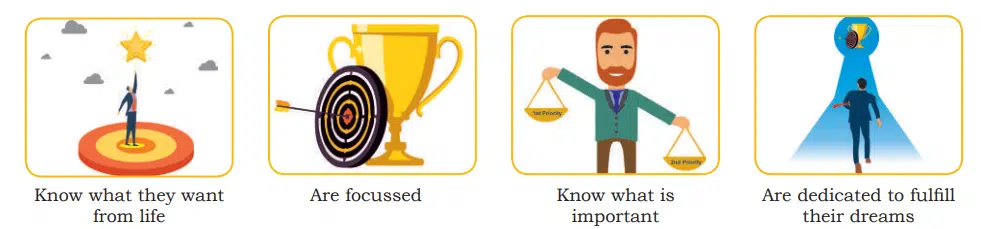
Building Self-motivation
- Find out your strengths
- Set and focus on your goals
- Develop a plan to achieve your goals
- Stay loyal to your goals
Session 4: Self-regulation— Goal Setting
What do you mean by goals and goals setting
- Goals: They are a set of dreams with a deadline to get them, for example, saving pocket money to buy a favorite mobile phone by a particular date.
- Goal setting: It is all about finding and listing your goals and then planning on how to achieve them.
How to set SMART Goals
SMART stands for Specific, Measurable, Achievable, Realistic and Time bound.
- Specific Goal
- Measurable
- Achievable
- Realistic
- Time bound
Session 5: Self-regulation— Time Management
Time Management and Its Importance
Time management is the ability to plan and control how you spend the hours of your day well and do all that you want to do.
Time management is the thinking skill that helps you to
- Complete tasks on time.
- Make a daily timetable.
- Make a good guess at how long it will take you to do something.
- Submit homework and assignments on time.
- Not waste time during the day.
Four Steps for Effective Time Management
- Organize: Arrange our daily tasks systematically.
- Prioritize: Create a to-do list and rank tasks by importance.
- Control: Manage activities and time effectively.
- Track: Identify and record how time is spent.
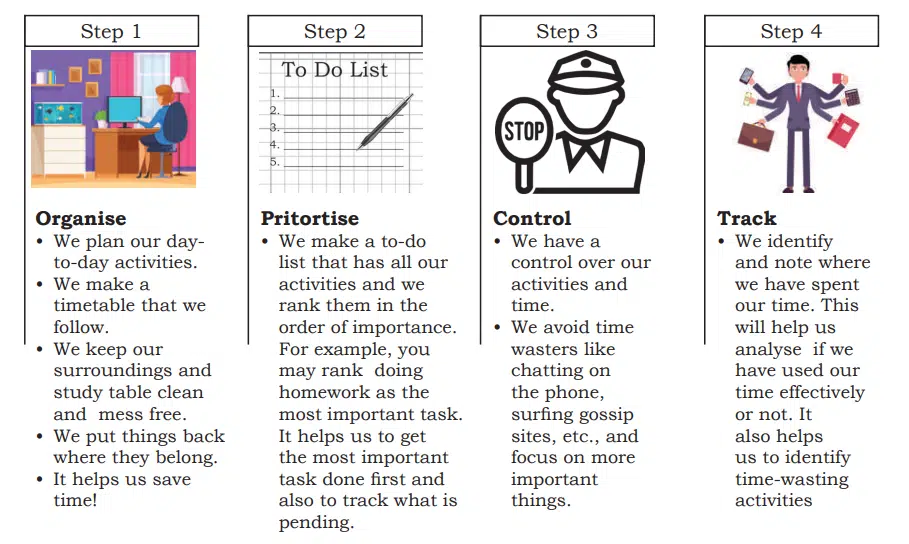
Tips for Practicing the Four Steps for Effective Time Management
- Avoid delay or postponing any planned activity
- Organise your room and school desk
- Develop a ‘NO DISTURBANCE ZONE’, where you can sit and complete important tasks
- Use waiting time productively
- Prepare a ‘To-do’ list
- Prioritise
- Replace useless activities with productive activities
Class 10 Employability Skills Unit 2 Self Management Skills – Important Question Answers
Section A: Multiple-Choice Questions (20 × 1 = 20 Marks)
Q1. Which of the following best describes self-management?
A. Depending on others to make decisions in difficult situations.
B. Controlling one’s emotions, thoughts and behaviour effectively in different situations.
C. Avoiding challenging tasks to maintain peace of mind.
D. Focusing only on professional goals while ignoring personal development.
Answer: B. Controlling one’s emotions, thoughts and behaviour effectively in different situations.
Q2. Rohan has several assignments due next week. He prepares a timetable, completes important tasks first and follows his schedule. Which self-management skill is he demonstrating most directly?
A. Emotional awareness
B. Adaptability
C. Self-motivation
D. Time management
Answer: D. Time management
Q3. A student feels anxious before an examination because they believe they have not prepared enough. In the ABC of stress management, the belief about being unprepared represents:
A. Beliefs
B. Adversity
C. Consequences
D. Adaptability
Answer: A. Beliefs
Q4. Which of the following is an example of stress being helpful?
A. A student loses sleep for several nights because of examination pressure.
B. A student becomes unable to concentrate because of continuous worry.
C. A deadline motivates a student to complete an assignment on time.
D. A student avoids school activities because of fear of failure.
Answer: C. A deadline motivates a student to complete an assignment on time.
Q5. Which action is most appropriate for reducing stress caused by disorganised academic work?
A. Postponing difficult assignments until the deadline approaches.
B. Organising class notes and tracking assignment deadlines.
C. Spending more time worrying about unfinished work.
D. Attempting all assignments simultaneously without a plan.
Answer: B. Organising class notes and tracking assignment deadlines.
Q6. Which of the following best demonstrates the ability to work independently?
A. Waiting for instructions before beginning every task.
B. Asking others to take responsibility for personal mistakes.
C. Completing only those tasks that are regularly monitored.
D. Recognising mistakes, correcting them and taking initiative.
Answer: D. Recognising mistakes, correcting them and taking initiative.
Q7. A student identifies that they become impatient during group discussions and decides to listen more carefully. This is an example of:
A. Self-awareness
B. External motivation
C. Time tracking
D. Adaptability
Answer: A. Self-awareness
Q8. Which approach is most effective for identifying personal strengths?
A. Comparing every achievement with that of classmates.
B. Ignoring feedback that does not match one’s opinion.
C. Reflecting on successful tasks and considering honest feedback from others.
D. Selecting strengths based only on activities that are popular among friends.
Answer: C. Reflecting on successful tasks and considering honest feedback from others.
Q9. Which statement correctly distinguishes interests from abilities?
A. Interests are always natural talents, whereas abilities are always learned.
B. Interests describe what a person enjoys, whereas abilities describe what a person can do effectively.
C. Interests and abilities always develop together and cannot differ.
D. Abilities describe what a person enjoys, whereas interests measure performance.
Answer: B. Interests describe what a person enjoys, whereas abilities describe what a person can do effectively.
Q10. Meera practises coding because she enjoys learning new programming concepts, even when no reward is offered. This is an example of:
A. External motivation
B. Peer motivation
C. Reward-based motivation
D. Internal motivation
Answer: D. Internal motivation
Q11. Suresh receives a prize after winning a race. He feels encouraged to practise every morning to earn further recognition. His motivation is primarily:
A. Internal motivation
B. Self-awareness
C. External motivation
D. Emotional awareness
Answer: C. External motivation
Q12. Which of the following is the most appropriate way to build self-motivation?
A. Identify strengths, set goals, develop a plan and remain committed to the goals.
B. Wait for appreciation before starting any challenging task.
C. Change goals whenever progress becomes difficult.
D. Focus on weaknesses without considering possible improvements.
Answer: A. Identify strengths, set goals, develop a plan and remain committed to the goals.
Q13. A student plans to improve their mathematics score by practising 10 questions daily for the next four weeks. Which SMART goal characteristic is most clearly demonstrated by specifying “10 questions daily”?
A. Realistic
B. Specific
C. Time-bound
D. Measurable
Answer: D. Measurable
Q14. Which goal is the best example of a SMART goal?
A. I will become excellent at every subject someday.
B. I will study more whenever I have free time.
C. I will improve my English marks by 10 points within two months by practising for 30 minutes daily.
D. I will try to score better than all my classmates.
Answer: C. I will improve my English marks by 10 points within two months by practising for 30 minutes daily.
Q15. In goal setting, what does the term “time-bound” mean?
A. The goal must be completed within a defined time period.
B. The goal must be achieved without changing any plans.
C. The goal must involve completing several tasks simultaneously.
D. The goal must be based entirely on available free time.
Answer: A. The goal must be completed within a defined time period.
Q16. A student has an important project and several less urgent activities. Which time-management step should the student use to rank tasks according to their importance?
A. Track
B. Control
C. Organise
D. Prioritise
Answer: D. Prioritise
Q17. Which sequence correctly represents the four steps for effective time management?
A. Prioritise → Organise → Track → Control
B. Organise → Prioritise → Control → Track
C. Control → Track → Organise → Prioritise
D. Track → Control → Prioritise → Organise
Answer: B. Organise → Prioritise → Control → Track
Q18. A student records how much time is spent studying, using social media and watching television. Which time-management step is being practised?
A. Organise
B. Prioritise
C. Track
D. Control
Answer: C. Track
Q19. Which of the following is the best example of emotional intelligence?
A. Ignoring emotions to finish tasks as quickly as possible.
B. Expressing every feeling immediately without considering its effect.
C. Avoiding people whose emotions differ from one’s own.
D. Recognising emotions, thinking rationally and regulating reactions appropriately.
Answer: D. Recognising emotions, thinking rationally and regulating reactions appropriately.
Q20. A student finds it difficult to concentrate while studying because of frequent phone notifications. Which action best applies the recommended time-management techniques?
A. Create a no-disturbance zone and replace distracting activities with productive ones.
B. Continue studying with notifications enabled to improve multitasking.
C. Postpone studying until all messages have been answered.
D. Remove all breaks from the study schedule to save time.
Answer: A. Create a no-disturbance zone and replace distracting activities with productive ones.
Section B: Short Question Answers
Q1. What is self-management? How does it help a person succeed in personal and professional life?
Answer: Self-management is the ability to control one’s emotions, thoughts and behaviour effectively. It helps people develop discipline, set goals, solve problems and improve their performance in personal and professional life.
Q2. What is stress? Explain the meaning of a stressor with one example.
Answer: Stress is an emotional, mental, physical or social reaction to perceived demands or threats. A stressor is the cause of stress, such as an upcoming examination for which a student feels unprepared.
Q3. Differentiate between helpful stress and harmful stress with one example of each.
Answer: Helpful stress motivates positive action, such as completing an assignment before a deadline. Harmful stress occurs when stress is excessive or prolonged, affecting health, concentration and daily activities.
Q4. Explain the ABC of stress management.
Answer: The ABC of stress management includes A – Adversity, the stressful event; B – Beliefs, how we interpret or respond to the event; and C – Consequences, the outcomes of our actions and responses.
Q5. Mention any four techniques that students can use to manage stress effectively.
Answer: Four stress-management techniques are time management, regular exercise and fresh air, maintaining a healthy diet, and getting adequate sleep. Positive thinking and organising academic work are also helpful.
Q6. What is emotional intelligence? Name its three key skills.
Answer: Emotional intelligence is the ability to identify and manage one’s own emotions and those of others. Its three key skills are emotional awareness, harnessing emotions, and managing emotions.
Q7. What does the ability to work independently mean? Mention any two characteristics of an independent worker.
Answer: Working independently means taking initiative and completing tasks without constant supervision. Two characteristics are recognising and correcting one’s mistakes and taking responsibility for assigned work.
Q8. Explain any three techniques for identifying personal strengths and abilities.
Answer: Personal strengths can be identified by reflecting on tasks performed successfully, considering what others appreciate about us, and spending time evaluating our abilities and achievements.
Q9. How can a person identify weaknesses and use feedback for self-improvement?
Answer: Weaknesses can be identified by recognising difficult tasks and reviewing feedback from others. Accepting feedback positively helps a person identify areas for improvement and develop better skills.
Q10. Differentiate between interests and abilities with a suitable example.
Answer: Interests are activities a person enjoys, while abilities are natural or acquired capacities to perform tasks effectively. For example, a student may enjoy singing but need more practice to sing well.
Q11. What is self-motivation? Differentiate between internal and external motivation with examples.
Answer: Self-motivation is the inner drive to act without constant external influence. Internal motivation comes from enjoyment or personal satisfaction, while external motivation comes from rewards, recognition or appreciation.
Q12. Mention any four steps that can help a person build self-motivation.
Answer: Four steps are identifying personal strengths, setting and focusing on goals, developing a plan to achieve them, and remaining committed to those goals.
Q13. What are goals and goal setting? Explain any two characteristics of a SMART goal.
Answer: Goals are targets a person wants to achieve, while goal setting involves identifying targets and planning how to reach them. SMART goals are specific, measurable, achievable, realistic and time-bound.
Q14. What is time management? Mention any three benefits of effective time management for students.
Answer: Time management is the ability to plan and control how time is spent. It helps students complete tasks on time, submit assignments before deadlines and reduce wasted time.
Q15. Explain the four steps of effective time management: Organise, Prioritise, Control and Track.
Answer:
- Organise: Arrange daily tasks systematically.
- Prioritise: Rank tasks according to importance.
- Control: Manage activities and time effectively.
- Track: Record and review how time is spent.
For complete study material, install the Android/iPhone app – Anjeev Singh Academy
By Anjeev Kr Singh – Computer Science Educator
Published on : October 18, 2026 | Updated on : October 18, 2026
About the Author