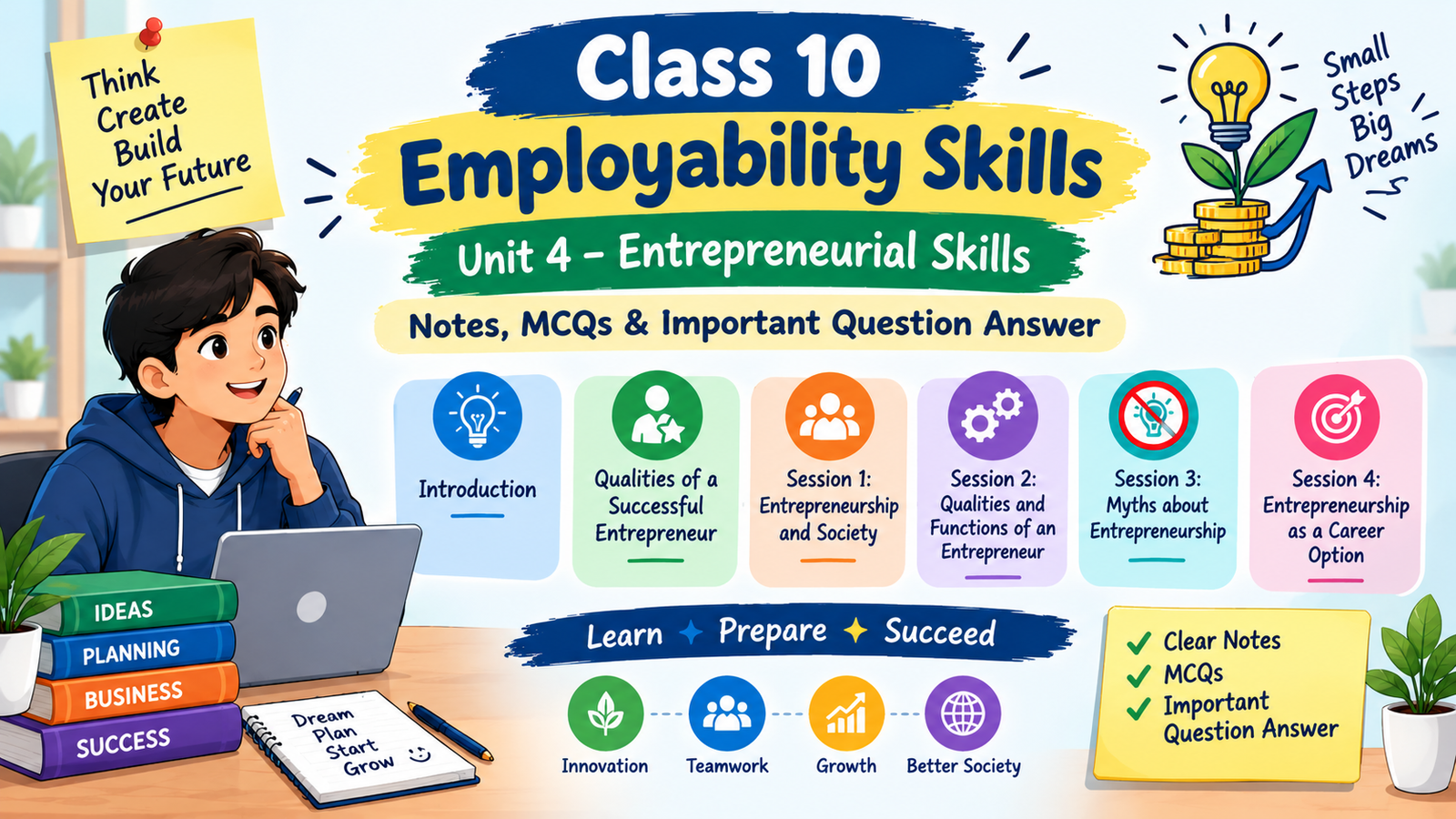
Unit 4 – Entrepreneurial Skills Notes, MCQs & Important Questions
Introduction
Entrepreneurship: Entrepreneurship is the type of self-employment where one is running a business to satisfy the needs of people and looking for ways to make the business better to make profits.
Entrepreneur: An entrepreneur is a person who is self-employed, is willing to take a calculated risk and brings in a new idea to start a business.
Qualities of a Successful Entrepreneur
Entrepreneurs are present all around us. The successful entrepreneurs have the following qualities.
- They are confident. They believe in themselves and their abilities.
- They keep trying new ideas in their business.
- They are patient.
- They are creative and think differently about business ideas.
- They take responsibility for their actions.
- They make decisions after thinking about them.
- They work hard.
- They do not give up when they face difficulty.
Session 1: Entrepreneurship and Society
Types of Employment
There are two ways / employement in which one can earn a living –
- Wage employment and
- Self-employment.
Wage Employment vs Self-Employment
| Wage employment | Self-employment |
| A person who works for an organization/another person and gets salary/wages. | A person runs their own business to satisfy the needs of people. |
A self-employed person who is always trying to make his/her business better by taking risks and trying new ideas is known as an entrepreneur.
Entrepreneur vs Businessman (Example)
- Ramu (Businessman): sits in a shop and sells when customers come.
- Ramya (Entrepreneur):
- goes out to bring customers
- adds new items (seeds, flowers) along with plants
- tries to grow business
How Entrepreneurs help in growing Area and Society?
In following ways Entrepreneurs help in growing the area and society they live in –
- Entrepreneurs run their businesses in a market.
- The market has people who buy products and services and people who sell them also.
- When people are buying and selling from each other, it is helpful for everyone because everyone involved makes money.
This is how entrepreneurs help in growing the area and society they live in.
What entrepreneurs do for society (Roles)
What do entrepreneurs do when they run their business –
- Fulfil Customer Needs: Entrepreneurs identify demands (find out what people want) and then create businesses to fulfill those needs/demands.
- Use Local Resources: Entrepreneurs use the material and people available around them, to make products at low cost.
- Help Society: Entrepreneurs contribute positively to society, some entrepreneurs work towards saving the environment, some give money to build schools and hospitals. This way, the people and area around them becomes better.
How entrepreneurs affect society (Impact)
Entrepreneurs affect society in many ways. Some of these are –
- Create Jobs: As business grows, Entrepreneurs hire more workers, buy more raw material, and increase employment opportunities.
- Lower Price of Products: As more entrepreneurs sell the same product, the competition increases and the price of the product goes down.
- Sharing of Wealth: Wealth means having enough money to live a comfortable life. As entrepreneurs grow their business, the people working for them and in related businesses also grow. They have more money to live a better-quality life.
Case Study: Bharti, the Jewellery Queen
- Identified demand: girls like earrings
- Used local resource: jute
- Helped village: bought jute from farmer + gave jobs to women
- As orders increased → hired more women → income increased for many.
Session 2: Qualities and Functions of an Entrepreneur
Quality
- A quality is the in which way a person acts/behaves (e.g., hardworking, patient, nice, rude, etc. ).
Qualities of an Entrepreneur
- Confidence – believes in self and takes business decisions.
- Keeps Trying new ideas – keeps experimenting.
- Patience – understands success takes time
- Creativity – thinks differently, finds unique solutions
- Responsibility – accepts mistakes and improves
- Decision after thinking – thinks good or bad, before deciding
- Hard work – works consistently
- Does not give up – stays strong during problems
Entrepreneurial qualities can be shown by anyone
- Even employees can be entrepreneurial if they:
- work hard
- think creatively
- try new methods to improve company work
Functions of an Entrepreneur –
Function means working in a way. Functions of an entrepreneur would be the work that an entrepreneur does. Common functions that all entrepreneurs do are –
- Making decisions – An entrepreneur can make decisions everyday. This includes
- what to produce or sell,
- how much and where to sell.
- Managing the business – An entrepreneur plans the future of his or her business. An entrepreneur
- arranges the raw material,
- hires the people and
- tells the employee what to do / assigns work
- checks whether plan is followed
- Dividing income – The entrepreneur divides the business money to many groups. The entrepreneur spends the money
- to buy material,
- give the salary and
- pay rent for the business & other expenses.
- Taking risk – Risk is the chance of something going wrong. An Entrepreneur takes risks against fires, theft, lost items etc.
- Create a new method, Idea or Product – An entrepreneur always trying/applies new things to increase their importance, business and income.
Session 3: Myths about Entrepreneurship
Myth/Misconception
A myth, or a misconception, is a false belief or opinion about something. .
- Example: “Tall people run faster than short people” (not always true).
- We have a misconception. It is not true. The truth is that short people can also run fast.
Misconceptions / Myths about Entrepreneurship
- Misconception 1: Every business idea needs to be unique or special.
Truth
- Ideas need not be completely new.
- You can take an existing business and add something different.
- Example: Ganesh car rental added luxury cars → grew big.
- Misconception 2: A person needs a lot of money to start a business.
Truth
- Money used to start business = Capital
- Not all businesses need huge capital.
- Start with available money/borrow → reinvest profits to grow.
- Misconception 3: Only a person having a big business is an entrepreneur.
Truth
- Even small business owners can be entrepreneurs if they:
- work for customer satisfaction
- improve service/ideas
Example: Sheila (taxi owner) added: - greeting customers
- newspaper
- small TV
- hospital/hotel numbers board
→ customers preferred her taxi.
- Misconception 4: Entrepreneurs are born, not made.
Truth
- Entrepreneurship can be learned through:
- practice
- experience
- skills + effort
If you try to make and sell something, you develop an entrepreneurial mindset.
Session 4: Entrepreneurship as a Career Option
Meaning of Career
A career is a line of work that a person takes for life. There are two ways a person can earn a living –
- Self-employment – Working for yourself, running your own business, example A graphic designer starting their own freelance design business.
- Wage employment – Working for someone else, earning a salary or hourly wage, for example An office worker employed by a company, receiving a monthly salary.
Example
- Doctor working in hospital → wage employed
- Doctor with own clinic → self-employed
- Self-employed + tries new ideas to satisfy customer needs → entrepreneur
Career Process:
A person who becomes an entrepreneur goes through a career process. This process is as follows:
- ENTER:
When an entrepreneur is starting, they are just entering the market to do business.
- Starting business; entering market
- Example: Sanjana is starting a small grocery store in a locality.
- SURVIVE
There are many entrepreneurs in the market. The entrepreneur has to remain in a competitive market.
- Facing competition and staying stable
- Example: there are many other grocery stores in the area. Yet, Sanjana’s store survives the competition and does well. She also expands the store to two more floors.
- GROW
Once the business is stable, an entrepreneur thinks about expanding his or her business.
- Expanding business after becoming stable
- Example: opening more branches in other areas/cities.
After five years, Sanjana has opened a chain of four more grocery stores in the same city. In the next two years, she plans to expand to tow other cities.
Entrepreneurship as a life option (Important points)
- Requires a lot of work and learning.
- If you believe in your idea → start.
- Risk exists, but without trying you won’t know success.
Class 10 Employability Skills – Unit 4: Entrepreneurial Skills
Frequently Asked Questions
Section A: Multiple Choice Questions
Q1. What is entrepreneurship?
a) Working for another person for a salary
b) Running a business to satisfy people’s needs and earn profit
c) Studying business management only
d) Working without taking responsibility
Answer: b) Running a business to satisfy people’s needs and earn profit
Q2. Who is an entrepreneur?
a) A person who only works for a salary
b) A person who avoids all risks
c) A self-employed person who takes calculated risks and tries new ideas
d) A person who never changes business methods
Answer: c) A self-employed person who takes calculated risks and tries new ideas
Q3. Which of the following is a quality of a successful entrepreneur?
a) Giving up easily
b) Avoiding decisions
c) Creativity
d) Ignoring customers
Answer: c) Creativity
Q4. How many main types of employment are discussed in the chapter?
a) One
b) Two
c) Three
d) Four
Answer: b) Two
Q5. Which of the following is an example of wage employment?
a) Running your own grocery shop
b) Starting a freelance business
c) Working for an organization and receiving a salary
d) Selling products through your own business
Answer: c) Working for an organization and receiving a salary
Q6. What distinguishes an entrepreneur from a typical businessman in the given example?
a) An entrepreneur never sells products
b) An entrepreneur looks for new ideas and ways to grow the business
c) An entrepreneur avoids customers
d) An entrepreneur never takes risks
Answer: b) An entrepreneur looks for new ideas and ways to grow the business
Q7. Which of the following is a way entrepreneurs help society?
a) By reducing employment opportunities
b) By preventing competition
c) By creating jobs
d) By wasting local resources
Answer: c) By creating jobs
Q8. What do entrepreneurs do to fulfil customer needs?
a) Ignore customer demands
b) Identify what people want and provide products or services
c) Sell only expensive products
d) Avoid improving their business
Answer: b) Identify what people want and provide products or services
Q9. Which resource did Bharti use to make jewellery in the case study?
a) Plastic
b) Jute
c) Iron
d) Glass
Answer: b) Jute
Q10. How did Bharti help the local community?
a) By importing all raw materials
b) By reducing the number of workers
c) By buying jute from farmers and providing jobs to women
d) By closing her business
Answer: c) By buying jute from farmers and providing jobs to women
Q11. What may happen when more entrepreneurs sell the same product?
a) Competition decreases
b) Prices may decrease
c) All businesses close
d) Customer needs disappear
Answer: b) Prices may decrease
Q12. Which of the following is a function of an entrepreneur?
a) Avoiding business decisions
b) Managing the business
c) Refusing to hire workers
d) Ignoring expenses
Answer: b) Managing the business
Q13. What does capital mean in entrepreneurship?
a) Money used to start a business
b) Profit earned every month
c) Salary paid to employees
d) The number of customers
Answer: a) Money used to start a business
Q14. Which of the following is an example of taking responsibility?
a) Blaming others for every mistake
b) Ignoring business problems
c) Accepting mistakes and trying to improve
d) Refusing to make decisions
Answer: c) Accepting mistakes and trying to improve
Q15. What is a myth or misconception?
a) A proven fact
b) A false belief or opinion
c) A business plan
d) A customer requirement
Answer: b) A false belief or opinion
Q16. Which statement about business ideas is correct?
a) Every business idea must be completely unique
b) Existing businesses cannot be improved
c) An existing business can grow by adding something different
d) Only new inventions can become businesses
Answer: c) An existing business can grow by adding something different
Q17. Which statement about entrepreneurs is a misconception?
a) Entrepreneurship can be learned through experience
b) Small business owners can be entrepreneurs
c) Entrepreneurs are born, not made
d) Entrepreneurs can improve their skills through practice
Answer: c) Entrepreneurs are born, not made
Q18. What is the first stage of the entrepreneurial career process?
a) Grow
b) Survive
c) Enter
d) Expand
Answer: c) Enter
Q19. What does the “Survive” stage mean in the entrepreneurial career process?
a) Starting a business for the first time
b) Remaining stable and facing competition in the market
c) Closing the business
d) Expanding into other cities immediately
Answer: b) Remaining stable and facing competition in the market
Q20. When does an entrepreneur enter the “Grow” stage?
a) Before starting the business
b) When the business becomes stable and the entrepreneur plans to expand
c) When the entrepreneur avoids customers
d) When the business stops operating
Answer: b) When the business becomes stable and the entrepreneur plans to expand
Section B: Short Question Answers
Q1. What is entrepreneurship?
Answer: Entrepreneurship is a type of self-employment in which a person runs a business to satisfy people’s needs, earns profits and looks for ways to improve the business.
Q2. Write any four qualities of a successful entrepreneur.
Answer: Four qualities of a successful entrepreneur are:
- Confidence
- Creativity
- Patience
- Hard work
Q3. Differentiate between wage employment and self-employment.
Answer:
- Wage employment: A person works for an organization or another person and receives a salary or wages.
- Self-employment: A person runs their own business to satisfy people’s needs.
Q4. How do entrepreneurs contribute to the development of society?
Answer: Entrepreneurs contribute to society by fulfilling customer needs, using local resources, creating employment opportunities, supporting social causes and helping improve people’s living standards.
Q5. How did Bharti help her village through her jewellery business?
Answer: Bharti identified the demand for earrings and used jute to make jewellery. She bought jute from local farmers and employed women from the village. As her business grew, she provided jobs to more women and helped increase their income.
Q6. What are the main functions of an entrepreneur?
Answer: The main functions of an entrepreneur are:
- Making business decisions.
- Managing the business and its resources.
- Dividing income among materials, salaries, rent and other expenses.
- Taking calculated risks.
- Developing new methods, ideas or products.
Q7. What is meant by a myth about entrepreneurship? Write any two myths.
Answer: A myth is a false belief or misconception about something.
Two myths about entrepreneurship are:
- Every business idea must be unique or special.
- A person needs a lot of money to start a business.
Q8. Explain the misconception “Entrepreneurs are born, not made.”
Answer: This is a misconception because entrepreneurship can be learned and developed through practice, experience, skills and effort. People can develop an entrepreneurial mindset by making and selling products or improving business activities.
Q9. Explain the three stages of the entrepreneurial career process.
Answer:
- Enter: The entrepreneur starts a business and enters the market.
- Survive: The entrepreneur faces competition and works to keep the business stable.
- Grow: The entrepreneur expands the business by opening new branches or entering new markets.
Q10. How can a person working as an employee demonstrate entrepreneurial qualities?
Answer: An employee can demonstrate entrepreneurial qualities by working hard, thinking creatively, taking responsibility, trying new methods and finding ways to improve the organization’s work.
Preparation tip:
Practise these 20 MCQs and 10 short question answers along with the chapter notes. Pay special attention to the functions and qualities of an entrepreneur, myths about entrepreneurship, Bharti’s case study, and the Enter–Survive–Grow career process. 📚
By Anjeev Kr Singh – Computer Science Educator
Published on : October 17, 2026 | Updated on : October 17, 2026
About the Author