
Class 10 Green Skills Notes, MCQs & Important Questions
Introduction
Environment and Our Life
- The environment around us affects all aspects of our life; and all our day-to-day activities also affect the environment.
- Cities depend on villages and natural ecosystems (forests, rivers, grasslands, seashores) for resources like water, fuelwood, fodder, etc.
- We use natural resources for food. Everything around us forms our environment and our lives depend on the natural world around us.
- Economic development has increased pollution.
- Example: high-input agriculture increases food production using fertilisers, pesticides, hybrid crops, but causes soil and environmental degradation.
- We must use resources in a sustainable way for present and future generations.
Session 1: Sustainable Development
What is Sustainable Development?
Sustainable development is the development that satisfies the needs of the present without compromising the capacity of future generations, guaranteeing the balance between economic growth, care for the environment and social well-being.
Meaning/Definition of Sustainable Development
Sustainable development is defined as ‘development that meets the needs of the present without compromising the ability of future generations to meet their own needs’ (World Commission on Environment and Development, 1987).
Sustainable development maintains balance between:
- economic growth
- environmental care
- social well-being
Importance of Sustainable Development
- Economic development is depleting global resources rapidly, posing severe environmental challenges for future generations. Rising population and incomes are driving up consumption, production, and the use of natural resources.
- To prevent environmental destruction, society must shift toward sustainable development, which requires individuals to adopt sustainable lifestyles and carefully utilize scarce natural resources..
Sustainable Agriculture
- Sustainable agriculture consists of environment friendly methods of farming that allow the production of agricultural crops or livestock without damage to human or natural systems.
- It also involves preventing the use of chemicals so as to avoid adverse effects to soil, water and biodiversity.
What are the problems related to Sustainable Development?
Three major problems related to sustainable development are –
(a) Food:
- The amount of rich, fertile land is becoming less.
- Soil nutrients are also getting depleted and
- Lots of chemicals are spoiling the soil due to use of chemical fertilisers.
(b) Water:
- We use fresh water from rivers and ponds but due to chemical fertilisers and industrial waste the rivers and ponds are getting polluted.
- This way after several years, we will have no clean water for our use.
(c) Fuel:
- We are using a lot of wood from trees as fuels and for construction of homes and furniture.
- As more and more trees are being cut, it is affecting the climate.
Environment-friendly Production of Power Energy
- An environment friendly way for production of power is using solar energy or energy from the sun which is unlimited.
- Solar energy is unlimited and eco-friendly.
- Example: Large scale production of solar power is seen in Charanka – Gujarat Solar Park (600 MW)
- reduces dependence on non-renewable fossil fuels in Gujarat.
- a good source of income to the people of Charanka.
- will also help future generations in the next 40–50 years to come.
What Sustainable Development Includes
Sustainable development includes
- Reducing excessive use of resources and enhancing resource conservation.
- Recycling and reuse of waste materials.
- Scientific management of renewable resources, especially bio-resources.
- Planting more trees.
- Green grassy patches and trees to be interspersed between concrete buildings;
- Using more environment friendly material or biodegradable material
- Use of technologies, which are environmentally friendly and based on efficient use of resources.
What do you mean by Sustainable Development Goals?
- SDGs are a universal call to:
- end poverty
- protect the planet
- ensure that all people enjoy peace and prosperity
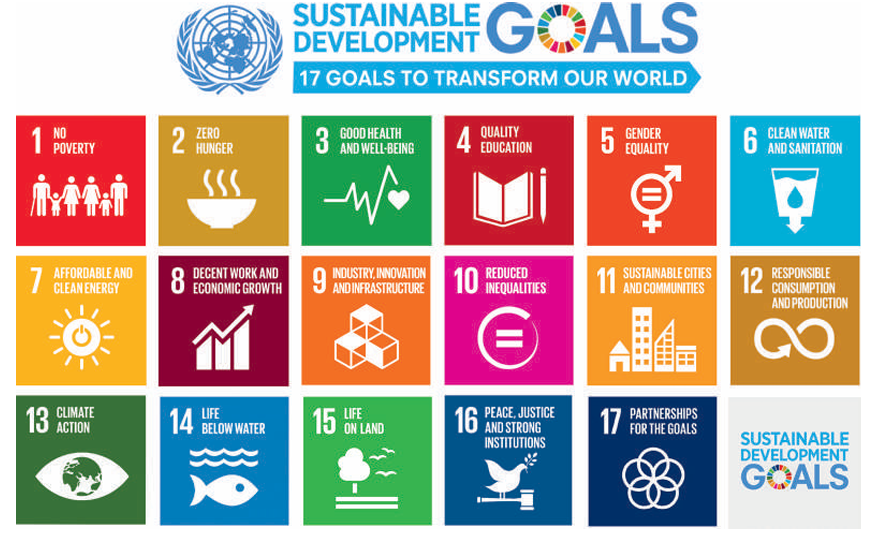
- The Sustainable Development Goals (SDGs) were launched by the United Nations Sustainable Development Summit in New York in September 2015, the agenda of sustainable development was countries should achieve the 17 sustainable development goals by 2030.
- The 17 SDGs have been made with the aim to take care of important issues facing businesses, governments and society.
- Some of these issues are poverty, gender equality, water use, energy, climate change and biodiversity.
17 Goals of SDG to transform our world are:
- No Poverty
- Zero Hunger
- Good Health and Well-being
- Quality Education
- Gender Equality
- Clean Water and Sanitation
- Affordable and Clean Energy
- Decent Work and Economic Growth
- Industry, Innovation and Infrastructure
- Reduced Inequalities
- Sustainable Cities and Communities
- Responsible Consumption and Production
- Climate Action
- Life Below Water
- Life On Land
- Peace, Justice and Strong Institutions
- Partnerships for the Goals
Sustainable Development Initiatives
Some people have taken sustainable development initiatives to improve the environment, society, and economy for the long term. For example:
- Biodegradable bags (Mr Avasth Hedge, Mangalore):
- 100% biodegradable, dissolves in hot water, decomposes naturally
- When plastics were banned by the municipal corporation of Mangalore, an innovator and entrepreneur Mr Avasth Hedge found an eco-friendly alternative.
- He made a 100 per cent bio-degradable bag which can dissolve in hot water and decompose in a natural environment.
- Edible cutlery (Narayana Peesapaty):
- made from grain, edible and decomposes easily, enriches soil
- To stop the use of plastics spoons, forks, etc. Narayana Peesapaty made edible cutlery made out of a grain — these spoons can be eaten and even if they are not eaten they will easily decompose in the soil enriching it.
Sustainable Process
Some practices are followed to help preserve the environment. These include:
- Organic farming
- Vermi-composting
- Rainwater harvesting
Organic farming is where farmers do not use chemical pesticides and fertilisers to increase their production.
- They use organic and natural fertilisers, such as cow dung to help in growing crops.
- This helps in better quality chemical free crops while at the same time maintaining the soil quality for future use.
- This is a true example of sustainable development where we are not only using the earth’s resources but are also preserving it for our future generations.
Session 2: Our Role In Sustainable Development
Why Our Role is Important
Increasing population and development has led to the increase in consumption of natural resources. The more the population, the more food, energy and water we need.
When we grow more crops, the soil’s nutrients are consumed and slowly the soil becomes unusable.
Similarly, if we continue to use fossil fuels, such as coal, oil and natural gas, very soon we will run out of these natural resources.
Factories give out smoke that pollutes the air. Garbage collected from homes is dumped into landfills. Untreated garbage can lead to disease and an unhealthy environment.
Sewage from the cities is dumped into the seas and lakes making it unsafe for marine life. This shows that though we are using the natural resources, we are doing nothing to return or give back to nature.
Natural resources are limited and with time they will get over and if we do not do anything about it, our future generations will not be able to survive.
Example Initiative: Kulhads by Indian Railways
- One initiative was taken by the Ministry of Railways in Varanasi and Raibareilly where they introduced Clay pots (‘Kulhads’) to replace plastic and paper cups and to bring back the taste of tradition.
Three major Advantages:
- reduce the cutting of trees for making paper cups.
- job creation for potters, which contributes to the economy.
- reduces plastic waste.
Our Role towards Sustainable Development
The United Nations has formed 17 Sustainable Development Goals (SDGs) so that countries and nations can work towards finding a solution to the growing problems in the world.
Countries should form rules and guidelines to remove poverty and hunger and provide good health and quality education.
These goals have been made so that all the nations take action to protect our air, water and land from pollution and provide clean water, air and energy to all people.
Sustainable development can actually happen only when each one of us works towards it. We have to become responsible environment citizens who can protect the environment through our own efforts.
Sustainable development happens only when individuals act responsibly.
Some basic ways in which people can help towards Sustainable Development Goals.
1. Quality Education
Education is the most important factors for sustainable development. Children who have gone to school
- will be able to do jobs, and
- They can take care of themselves and their families.
Education helps us become aware of our role as a responsible citizen. We should
- use the local education facilities present in our areas.
- take our friends to school.
- help friends study.
- stop friends from dropping out of school.
2. Clean Water and Sanitation
- We must make efforts to make India free of open defecation by building toilets and creating awareness towards sanitation.
- Industrial pollution polluting our water resources, which in near future will cause scarcity of clean drinking and usable water.
- Measurable Step: We must promote awareness to keep water sources clean.
3. Affordable and Clean Energy
- Solar Power is known as Affordable and clean energy.
- Using solar power i.e., power generated using the sun does not cause pollution as it does not require burning of non-renewable fuels, such as coal.
- We are making efforts to increase the solar power generation so that our electricity needs are met and at the same time we do not pollute the environment or use up natural resources.
- Use of biogas is also an eco-friendly alternative to natural gas.
4. Decent Work and Economic Growth
We can
- Study and find good jobs to take care of ourselves and our families.
- Work hard and contribute to society.
- Learn and develop skills so that we add value in our community.
5. Reduced Inequalities
To reduce inequalities, we can
- be helpful to one another.
- be friendly with everyone.
- include everyone while working or playing.
- help others by including everyone whether they are small or big, girl or boy, belong to any class or caste.
6. Sustainable Cities and Communities
Creating Sustainable Cities
- Save energy by switching off lights and fans when not in use.
- Use natural light as much as possible.
- Use energy efficient lights (LED bulbs) and appliances.
7. Responsible Consumers and Producers
We can become responsible about our own environment by
- Reusing paper, glass, plastic, water, etc.
- Taking cloth bags to market carrying fruits and vegetables.
- Donate things we do not use such as clothes, books, furniture, food, etc.
- Buy and eat seasonal fruits and vegetables from local growers.
- Repair leaking taps and pipes to avoid wasting water.
- Sort and treat garbage before disposing.
8. Protect Life Below Water
Tons of plastic are found in the seas, which is killing marine life. Protecting marine life, saving our oceans from pollution is necessary to preserve marine life.
9. Protect Life on Land
Cutting of trees is leading to soil erosion and making land dry and unusable for cultivation. Planting more tree to replace the ones that we have cut is an important step towards sustainable development.
Class 10 Green Skills: 15 MCQs and Short Question Answers
Frequently Asked Questions and Answers
Section A: Multiple-Choice Questions (MCQs)
Q1. What is the main objective of sustainable development?
(a) To increase industrial production at any cost
(b) To meet present needs without compromising future generations
(c) To use all available natural resources
(d) To stop all economic activities
Answer: (b) To meet present needs without compromising future generations
Q2. Which three aspects must be balanced for sustainable development?
(a) Education, transport and communication
(b) Agriculture, industry and trade
(c) Economic growth, environmental care and social well-being
(d) Population, technology and employment
Answer: (c) Economic growth, environmental care and social well-being
Q3. In which year were the Sustainable Development Goals (SDGs) launched?
(a) 2000
(b) 2010
(c) 2015
(d) 2020
Answer: (c) 2015
Q4. By which year were countries expected to achieve the 17 Sustainable Development Goals?
(a) 2025 (b) 2030 (c) 2040 (d) 2050
Answer: (b) 2030
Q5. Which of the following is an example of sustainable agriculture?
(a) Excessive use of chemical fertilisers
(b) Cutting trees to increase farmland
(c) Using organic fertilisers such as cow dung
(d) Dumping industrial waste into rivers
Answer: (c) Using organic fertilisers such as cow dung
Q6. Which of the following is a major problem related to food and sustainable development?
(a) Increase in soil fertility everywhere
(b) Depletion of soil nutrients
(c) Unlimited availability of fertile land
(d) Reduction in the use of chemicals
Answer: (b) Depletion of soil nutrients
Q7. Charanka Solar Park is located in which Indian state?
(a) Rajasthan
(b) Haryana
(c) Gujarat
(d) Punjab
Answer: (c) Gujarat
Q8. What is one major benefit of solar energy?
(a) It requires burning coal
(b) It increases air pollution
(c) It is a non-renewable resource
(d) It is an eco-friendly source of energy
Answer: (d) It is an eco-friendly source of energy
Q9. Who developed edible cutlery as an alternative to plastic spoons and forks?
(a) Narayana Peesapaty
(b) Avasth Hedge
(c) Bhagat Singh
(d) Verghese Kurien
Answer: (a) Narayana Peesapaty
Q10. Which of the following is a sustainable process?
(a) Open defecation
(b) Excessive deforestation
(c) Vermi-composting
(d) Dumping untreated sewage
Answer: (c) Vermi-composting
Q11. What was one advantage of introducing kulhads by Indian Railways?
(a) Increased plastic waste
(b) Creation of employment for potters
(c) Increased use of paper cups
(d) Increased cutting of trees
Answer: (b) Creation of employment for potters
Q12. Which of the following helps achieve the SDG of Affordable and Clean Energy?
(a) Burning more coal (b) Increasing the use of fossil fuels (c) Using solar power (d) Wasting electricity
Answer: (c) Using solar power
Q13. Which action promotes responsible consumption and production?
(a) Throwing away usable clothes
(b) Buying unnecessary products
(c) Using disposable plastic bags regularly
(d) Reusing paper, glass and plastic
Answer: (d) Reusing paper, glass and plastic
Q14. What is a major environmental consequence of cutting trees?
(a) Reduced soil erosion (b) Increased soil erosion (c) Increased soil fertility in all areas (d) Reduced land degradation
Answer: (b) Increased soil erosion
Q15. Which action supports the SDG of Quality Education?
(a) Encouraging friends to drop out of school
(b) Avoiding local educational facilities
(c) Helping friends study and preventing school dropouts
(d) Restricting education to a few people
Answer: (c) Helping friends study and preventing school dropouts
Section B: Short Question Answers
Q1. What is sustainable development?
Answer: Sustainable development is development that meets the needs of the present without compromising the ability of future generations to meet their own needs.
Q2. Name the three main aspects of sustainable development.
Answer: The three main aspects are economic growth, environmental care and social well-being.
Q3. Why is sustainable development important?
Answer: It is important because natural resources are limited, and their excessive use causes environmental damage and threatens the needs of future generations.
Q4. What is sustainable agriculture?
Answer: Sustainable agriculture involves environment-friendly farming methods that produce crops or livestock without damaging human or natural systems.
Q5. Mention any two problems related to sustainable development.
Answer: Any two problems are depletion of soil nutrients and pollution of freshwater sources.
Q6. What is the importance of solar energy in sustainable development?
Answer: Solar energy is renewable and eco-friendly. It reduces dependence on non-renewable fossil fuels and helps meet electricity needs with less pollution.
Q7. What are Sustainable Development Goals (SDGs)?
Answer: SDGs are 17 global goals launched by the United Nations in 2015 to end poverty, protect the planet and ensure peace and prosperity for all by 2030.
Q8. What is organic farming?
Answer: Organic farming is a method of farming in which chemical pesticides and fertilisers are avoided and natural fertilisers, such as cow dung, are used.
Q9. How do biodegradable bags help protect the environment?
Answer: Biodegradable bags decompose naturally and provide an eco-friendly alternative to conventional plastic bags, reducing plastic pollution.
Q10. What is edible cutlery? Who developed it?
Answer: Edible cutlery consists of utensils made from grain that can be eaten or allowed to decompose naturally. It was developed by Narayana Peesapaty.
Q11. Why is our role important in sustainable development?
Answer: Our role is important because responsible individual actions help conserve natural resources, reduce pollution and protect the environment for future generations.
Q12. Mention any three advantages of using kulhads instead of plastic and paper cups.
Answer:
- They reduce plastic waste.
- They create employment for potters.
- They reduce the cutting of trees required to make paper cups.
Q13. How can we help achieve the SDG of Clean Water and Sanitation?
Answer: We can keep water sources clean, spread awareness about sanitation, use toilets and help prevent water pollution.
Q14. Mention any three ways to become a responsible consumer.
Answer:
- Reuse materials such as paper, glass and plastic.
- Carry cloth bags while shopping.
- Repair leaking taps and pipes to avoid wasting water.
Q15. How can we protect life below water and life on land?
Answer: We can protect life below water by preventing plastic and other waste from entering water bodies. We can protect life on land by planting trees and reducing deforestation.
By Anjeev Kr Singh – Computer Science Educator
Published on : October 17, 2026 | Updated on : October 17, 2026
About the Author