Class 10 Communication Skills Notes, MCQs and Question Answer
Introduction
In the present time, a thorough knowledge of language with communication skills is very important in any occupation or business. Speaking more than one language can help you to communicate well with people around the world.
Learning English can help you to communicate with people who understand English besides the mother tongue i.e., the language one has been exposed to since birth.
Session 1 : Method of Communication
What is Communication
The word ‘communication’ comes from the Latin word commūnicāre, meaning ‘to share’. Communication is a method where we can exchange information between two or more people.
Communication Skills are needed to communicate effectively with people and customers.
- Clear and concise communication is of immense importance in work and business environment
Definition: Communication is the process of conveying information, knowledge, feelings, or ideas through speaking, writing, or using body language.
Parts of Communication
 Communication has three important parts –
- Transmitting: When someone sends a message or information to others.
- Listening: The receiver listens to or understands the message.
- Feedback: The receiver gives a message to the sender in the form of feedback to complete the communication cycle.
Process of Communication:
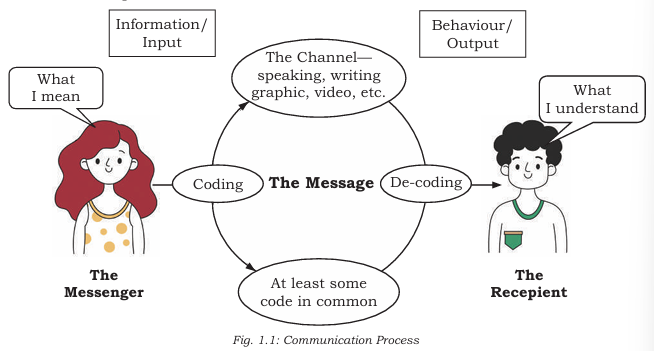
Elements of Communication
 The various elements of a communication cycle are:-
- Sender: The person beginning the communication.
- Message: The information that the sender wants to share, like ideas, information, questions, etc.
- Channel: Channel means how the message is sent to others, like using spoken word, gestures, emails, phone calls, etc.
- Receiver: The person who receives the message.
- Feedback: The receiver’s acknowledgement and response to the message.
Method of Communications
| Method of Communication | Description |
| Face-to-face informal communication | Face-to-face communication is the easiest, quickest and best method for sharing information. It helps the message to be understood clearly and quickly. Due to body language, it adds effectiveness in communication. |
| E-mail can be used to communicate quickly with one or many individuals in various locations. It offers flexibility, convenience and low-cost. | |
| Notices/Posters | It is helpful when the same message has to be conveyed to a large group of people. For example: ‘Shop closed on Sunday’Generally used for where email communication may not be effective. |
| Business Meetings | Communication during business meetings at an organisation are generally addressed to a group of people. It can be related to business, management and organisational decisions. |
| Other Methods | Some other communication methods are used, like social networks, messages, phone calls for communication, newsletters, blogs, etc. |
How to choose the Right Method of Communication?
Right method of communication depends on –
- Target audience
- Costs of communication
- Kind/type of information
- Urgency/priority
Communication plays a vital role in your relationship with peers, supervisors and customers. So you must consider all factors while choosing the right method of communication.
Class 10 Employability Skills – Unit 1 Communication Skills II
Session 2: Verbal Communication
What is Verbal Communication
Verbal communication is an exchange of information using spoken or written words to convey thoughts, ideas and emotions. Verbal communication includes sounds, words, language, and speech.
Speaking is one of the most effective and commonly used ways of communicating. By improving your verbal communication skills you will build rapport, and have a better connection.
Types of Verbal Communication
There are several types of verbal communication –
| Type of Verbal Communication | Description |
| Interpersonal Communication | This form of communication takes place between two individuals. Also known as one-on-one conversation. It can be formal and informal.Examples:A manager discussing the performance with an employee.Two friends discussing homework. Two people talking to each other over phone or video call. |
| Written Communication | This form of communication involves writing words. It can be letters, circulars, reports, manuals, SMS, social media chats, etc.It can be between two or more people.Examples: A manager writing an appreciation e-mail to an employee.Writing a letter to grandmother enquiring about health. |
| Small Group Communication | This type of communication takes place when there are more than two people involved. Examples: Press conferences Board meetings, Team meetings |
Advantages of Verbal Communication
- Ease: Simple and straightforward way of communication.
- Adaptability: Allows for adjustments based on the listener’s response.
- Immediacy: Enables quick exchange of information.
- Clarity: Facilitates clear understanding through spoken words.
Disadvantages of Verbal Communication
- Dependency on Words: Relies on the accuracy of spoken words, leading to potential misunderstandings.
- Lack of Permanent Record: Information is not always documented, making it challenging to reference.
- Limited Non-Verbal Cues: Absence of visual and body language cues can lead to misinterpretations.
- Potential for Confusion: Without precise wording, meanings may be unclear or confusing.unication courses
Mastering Verbal Communication:
Most people tend to get nervous while speaking in front of a large group, or even while speaking to their teachers, managers or supervisors.
Follow these points to master in Verbal Communication:
- Think Before You Speak
- Think about your topic.
- Think about the most effective ways to make your listeners understand the topic.
- Write or note down whatever you plan to say.
- Concise and Clear
- Speak clearly, loudly and at moderate speed.
- Be sure the information you want to share is to the point.
- Do not repeat the same sentences.
- Confidence and Body Language
- Be confident.
- Maintain eye contact, stand straight and be attentive.
- Be friendly
Class 10 Employability Skills – Unit 1 Communication Skills II
Session 3: Non-verbal Communication
What is non-Verbal Communication
Non-verbal communication is a process  of conveying messages without using spoken or written words.
Non-verbal communication uses facial-expressions, body language, gestures, postures, touch, space, eye contact and para language for conveying the message.
 Importance of Non-verbal Communication
In our day-to-day communication:
- 55% communication is done using body movements, face, arms, etc.
- 38% communication is done using voice, tone, pauses, etc.
- Only 7% communication is done using words.
Note: Around 93% of our communication is non-verbal.
Example:
Certain examples of communicating with tone of voice and body language
| Non-Verbal Communication | Examples |
| Gestures | 1. Raising a hand to greet or say goodbye.2. Pointing a finger at someone. |
| Expressions | 1. Smiling when happy.2. Making a sad face when sad. |
| Body Language | 1. Postures by which attitudes and feelings are communicated.2. Standing straight, showing interest. |
These are the importance of Non-Verbal Communication:
- Our message becomes more effective if we use the right gestures while communicating.
- If we know about non-verbal communication, we can understand our audience’s reaction and adjust our interaction accordingly.
- Using the right gestures and postures is a sign of professionalism and etiquette.
- If verbal messages are obstructed by noise or distance, etc., we can use our hand movements to exchange messages. For example, placing a finger on the lips indicates the need for silence while nodding the head is the same as saying ‘yes’.
Different Types of non-verbal communication
| Type | What it means | How to use it effectively? |
| Facial Expressions | Our expressions can show different feelings, such as Happiness, Sadness, Anger, Surprise, Fear, etc. | a. Smile when you meet someone.b. Keep your face relaxed.c. Match your expressions with your words.d. Nod while listening. |
| Posture | Postures show our confidence and feelings. For example, a straight body posture shows confidence while a slumped posture is a sign of weakness. | a. Keep your shoulders straight and body relaxed.b. Sit straight while resting your hands and feet in relaxed position.c. While standing, keep your hands by your sides. |
| Gestures or Body Language | Gestures include body movements that express an idea or meaning. For example, raising a hand in class to ask a question and biting nails when nervous. | a. Keep your hands open.b. Avoid pointing your finger at people.c. Tilt your head a bit to show that you are attentive |
| Touch | We communicate a great deal through touch. For example, a firm handshake to display confidence and pat on the back to encourage someone | a. Shake hands firmly while meeting someone.b. Avoid other touch gestures during formal communication. |
| Space | Space is the physical distance between two people. The space between two persons while communicating, generally depends on the intimacy or closeness between them. | a. Maintain proper space depending on the relationship, which could be formal or informal or the closeness with the person with whom you are talking. |
| Eye Contact | The way we look at someone can communicate a lot. Eye contact shows that we are paying attention to the person as opposed to looking away, which can make the other person feel ignored. | a. Look directly at the person who is speaking.b. Avoid staring; keep a relaxed look.c. Maintain eye contact with intermittent breaks. |
| Paralanguage | How we speak affects our communication and includes the tone, speed and volume of our voice. For example, talking fast may show happiness, excitement or nervousness while speaking slow may show seriousness or sadness | a. Use a suitable tone and volumeb. Maintain a moderate speed while talking |
What is Visual Communication
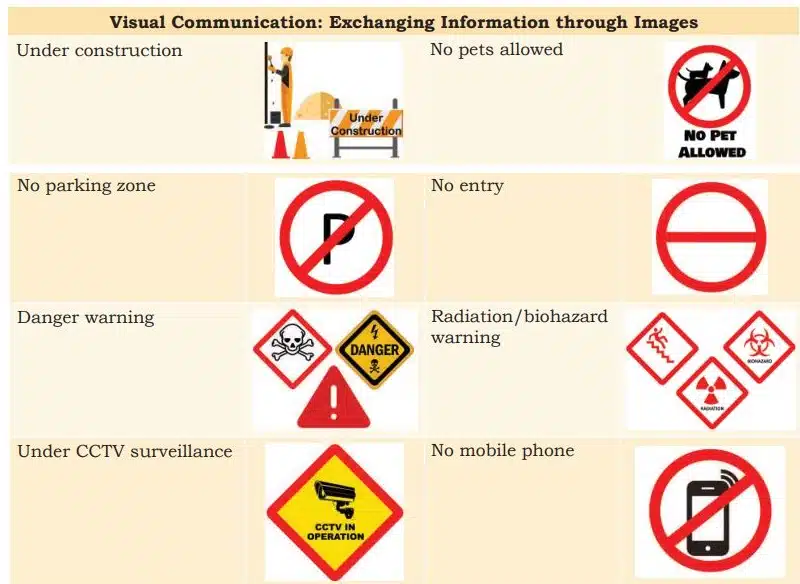
Visual communication conveys the messages through images, pictures, videos and symbols. It is an effective way of communication.
Why is Visual Communication effective?
- Visual communication proves to be effective since it involves interchanging messages only through images or pictures and therefore, you do not need to know any particular language for understanding it.
- It is simple and remains consistent across different places.
Some common types of visual communication are
Class 10 Employability Skills – Unit 1 Communication Skills II
Session 4: Communication Cycle and Importance of Feedback
What is Feedback
When a sender shares information, the receiver responds with feedback, which can be positive or negative. Feedback is an important part of the communication cycle.
For effective communication, it is important that the sender receives an acknowledgement from the receiver about getting the message across. Feedback can be positive or negative.
A good/effective feedback is always-
- Specific 2. Helpful 3. Kind
Different types of Feedback in Communication Cycle
Type of Feedback Examples
| Types of Feedback | Examples |
| Positive Feedback | a. I noticed you finished the work perfectly. Great job!b. I really appreciate you taking that call. Can you please also share the details? |
| Negative Feedback | a. You keep forgetting to smile at the hotel guests when you talk to them.b. You take really long to reply to e-mails! Are you always so busy? |
| No Feedback | a. It is also feedback in itself which indicates disagreement of ideas. |
Effect of Feedback
Feedback, if shared properly, can help reinforce existing strengths and can increase the recipient’s abilities to rectify errors. It can have a long-term effect in managing and achieving goals.
What do you mean by good feedback?
Good feedback is one that –
- Specific
- Timely
- Polite
- Offering continuing support
What is the importance of Feedback
Feedback is the final component and one of the most important factors in the process of communication since it is defined as the response given by the receiver to the sender.
Why feedback is important?
- It validates effective listening
- It Motivates
- It Boost Learning
- It improves performance.
Class 10 Employability Skills – Unit 1 Communication Skills II
Session 5: Barriers to Effective Communication
Effective Communication
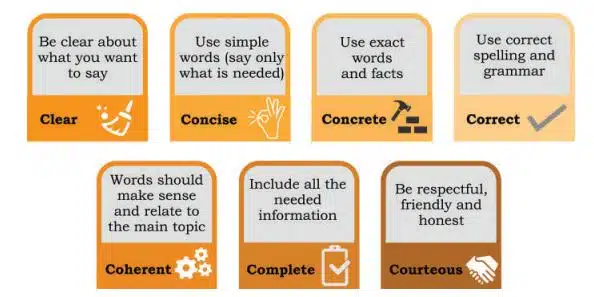
There are different methods of communication: non-verbal, verbal and visual. However, all these methods can only be effective if we follow the basic principles of professional communication skills i.e. 7Cs i.e. i.e., Clear, Concise, Concrete, Correct, Coherent, Complete and Courteous.
Absence of any of these 7Cs can lead to miscommunication.
What is 7Cs of Effective Communication
Essential Principles for Effective Communication:
- Clear: Make your message easy to understand.
- Concise: Use a simple and short message; avoid unnecessary details.
- Concrete: Use specific words and real facts.
- Correct: Check your spelling and grammar to avoid confusion.
- Coherent: Ensure your words logically connect and relate to the main topic.
- Complete: Include all necessary information for a complete message.
- Courteous: Be polite, respectful, and truthful in your communication.
What are the different barriers to Effective Communication
 Physical Barriers: When distance, noise or surroundings create challenges, it is known as a physical barrier. For example, a weak phone signal can create physical barriers.
- Linguistic Barriers: A language barrier occurs when people use different languages. It is the most common communication barrier.
- Interpersonal Barriers: Sometimes, people misunderstand each other’s messages because of tone, emotions or personal biases.
- Organisational Barriers: When the organisational hierarchy, rules and regulations, procedures, policies and norms are not followed by the employee.
- Cultural Barriers: Cultural barriers are when people of different cultures are unable to understand each other’s customs, resulting in inconveniences and difficulties.
What are the ways to overcome Barriers of Effective Communication
- Use simple language
- Do not form assumptions on culture, religion or geography
- Try to communicate in person as much as possible
- Use visuals
- Take help of a translator to overcome differences in language
Be respectful of other’s opinions
Session 6: Writing Skills — Parts of Speech
Writing skills are part of verbal communication and include e-mails, letters, notes, articles, SMS/chat, blogs, etc. all these forms of written communication, we use sentences to express ourselves.
What is Sentence
Sentence is a group of words that communicates a complete thought. A sentence always begins with a capital letter, and it always ends with a question mark, full stop or exclamation mark. For example, Pooja goes to school.
What is Phrase
The group of words, which does not make complete sense, is known as a phrase. For example, Pooja goes.
What are the different capitalization rules in communication cycle
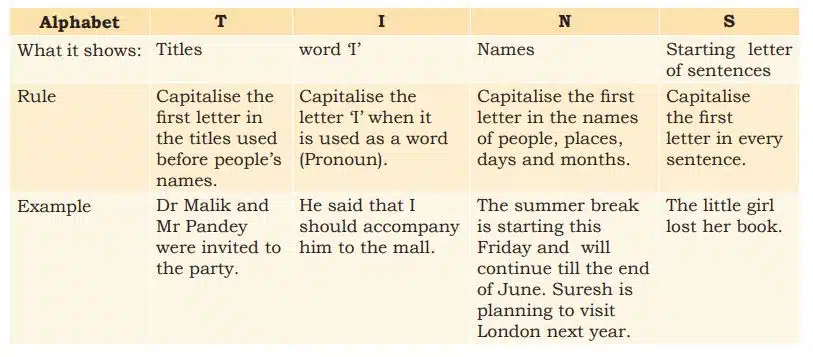
We know that all sentences begin with capital letters. However, there are certain other points in a sentence where we should use capital letters. ‘TINS’ is a set of simple rules that help you capitalise words correctly.
| Alphabet | T | I | N | S |
| What it shows: | Titles | Word ‘I’ | Names | Starting letter of sentences |
| Rule | Capitalise the first letter used in titles. | Capitalise the letter ‘I’ when it is used as a word (Pronoun). | Capitalise the first letter of people, places and days and months. | Capitalise the first letter in every sentence. |
| Example | Dr Malik and Mr Pandey were invited to the party. | He said that I should accompany him to the mall. | The summer break is starting this Friday and will continue till the end of June. Suresh is planning to visit London next year. | The little girl lost her book. |
What do you mean by punctuation rules
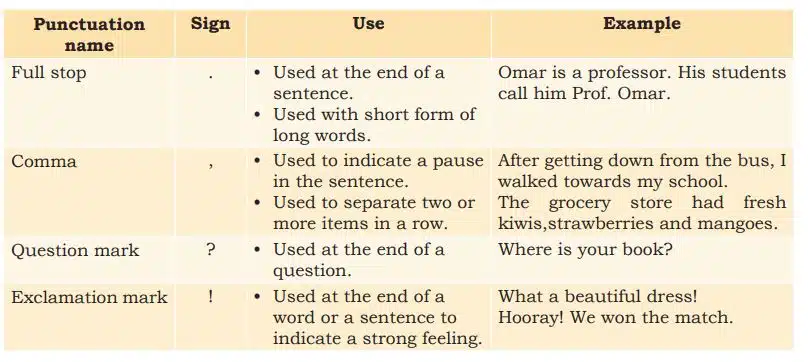
Certain set of marks, such as full stop, comma, question mark, exclamation mark and apostrophe are used in communication to separate parts of a sentence for better clarity of message.
| Punctuation Name | Sign | Use | Example |
| Full stop | . | Used at the end of a sentence.Used with short form of long words. | Omar is a professor. His students call him Prof. Omar. |
| Comma | , | Used to indicate a pause in the sentence.Used to separate two or more items in a row. | After getting down from the bus, I walked towards my school.The grocery store had fresh kiwis, strawberries and mangoes. |
| Question mark | ? | Used at the end of a question. | Where is your book? |
| Exclamation mark | ! | Used at the end of a word or a sentence to indicate a strong feeling. | What a beautiful dress!Hooray! We won the match. |
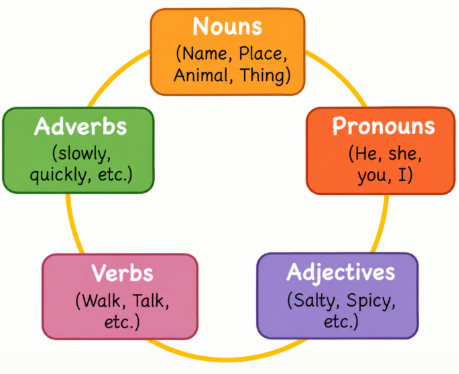
What are the basic parts of speech
The part of speech indicates how a particular word functions in meaning as well as grammatically within the sentence.
- Noun – Names a person, place, thing, or idea. (e.g., dog, city)
- Pronoun – Replaces a noun to avoid repetition. (e.g., he, she, it)
- Verb – Expresses action or state of being. (e.g., run, exist)
- Adjective – Describes or modifies a noun. (e.g., happy, tall)
- Adverb – Modifies a verb, adjective, or another adverb. (e.g., quickly, very)
What are the different supporting parts of speech
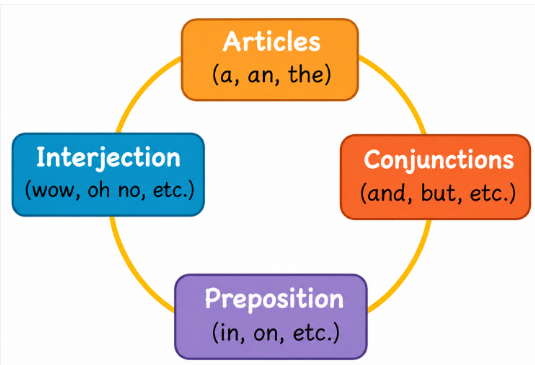
- Article – A type of adjective that defines a noun as specific or unspecific. (e.g., a, an, the)
- Conjunction – Connects words, phrases, or clauses. (e.g., and, or, but)
- Preposition – Indicates the relationship between a noun and another word. (e.g., in, on, under)
- Interjection – Expresses strong emotions but is not grammatically related to the rest of the sentence. (e.g., wow, oh)
Session 7: Writing Skills—Sentences
What is sentence
A sentence is a group of words that conveys a complete thought. It consists of a subject (the main actor or topic) and a predicate (the action or what the subject does). A sentence can be simple, compound, or complex, and it is the basic unit of communication in written and spoken language.
What are the different parts of a sentence
There are basically three different parts of sentence –
- Subject – The person or thing performing the action.
- Verb – Describes the action carried out by the subject.
- Object – The person or thing that receives the action.
What are the different types of objects
In a sentence, there can be two types of objects — Direct and Indirect.
Direct Object:
- Receives the action directly from the verb.
- Answer the question “what” or “whom.”
- Example: She ate an apple.
Indirect Object:
- Indirectly affected by the action, often preceded by a preposition.
- Answer the question “to whom” or “for whom.”
- Example: He gave a gift to her.
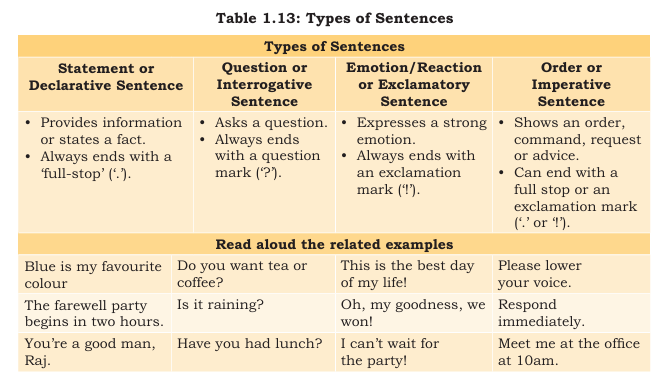
What are the different types of sentences
- Statement or Declarative Sentence
- Question or Interrogative Sentence
- Emotion/Reaction or Exclamatory Sentence
- Order or Imperative Sentence
What do you mean by Active and Passive Sentences
Active Sentence:
- The subject performs the action.
- Example: The cat (subject) chased the mouse (object).
Passive Sentence:
- The subject receives the action.
- The object becomes the focus.
- Example: The mouse (object) was chased by the cat.
What do you mean by paragraph
A paragraph is a collection of sentences centered around a single idea. It starts with a topic sentence, followed by supporting details, and often ends with a concluding sentence. This structure enhances organization and readability in written communication.
Class 10 Employability Skills – Unit 1 Communication Skills II
Important MCQs and Question Answers
Section A: Multiple-Choice Questions (25 MCQs)
Q1. The word ‘communication’ comes from which Latin word?
(a) Communitas
(b) Communicare
(c) Communicatus
(d) Communico
Answer: (b) Communicare
Q2. Which of the following is the correct sequence of the three important parts of communication?
(a) Feedback, Listening, Transmitting
(b) Listening, Transmitting, Feedback
(c) Transmitting, Listening, Feedback
(d) Listening, Feedback, Transmitting
Answer: (c) Transmitting, Listening, Feedback
Q3. Which element of communication refers to the person who begins the communication?
(a) Sender
(b) Receiver
(c) Channel
(d) Feedback
Answer: (a) Sender
Q4. Which method of communication is most suitable for conveying the same message to a large group of people?
(a) One-to-one conversation
(b) Telephone call
(c) Personal discussion
(d) Notices and posters
Answer: (d) Notices and posters
Q5. Which factor should be considered while choosing the right method of communication?
(a) Target audience
(b) Cost of communication
(c) Urgency of information
(d) All of the above
Answer: (d) All of the above
Q6. Which type of verbal communication takes place between two individuals?
(a) Visual communication
(b) Interpersonal communication
(c) Small group communication
(d) Mass communication
Answer: (b) Interpersonal communication
Q7. Which of the following is a disadvantage of verbal communication?
(a) It allows quick exchange of information
(b) It can be adjusted according to the listener
(c) It may lack a permanent record
(d) It facilitates understanding through words
Answer: (c) It may lack a permanent record
Q8. Which practice helps a person improve verbal communication?
(a) Repeating the same sentences
(b) Speaking too quickly
(c) Avoiding eye contact
(d) Thinking before speaking
Answer: (d) Thinking before speaking
Q9. What percentage of communication is attributed to words in the study material?
(a) 7%
(b) 38%
(c) 55%
(d) 93%
Answer: (a) 7%
Q10. Which of the following is an example of a gesture?
(a) Writing an email
(b) Reading a notice
(c) Raising a hand to greet someone
(d) Making a phone call
Answer: (c) Raising a hand to greet someone
Q11. Which type of non-verbal communication involves tone, speed and volume of voice?
(a) Posture
(b) Paralanguage
(c) Space
(d) Touch
Answer: (b) Paralanguage
Q12. What does maintaining appropriate eye contact generally show?
(a) Lack of attention
(b) Disinterest
(c) Nervousness in every situation
(d) Attention to the speaker
Answer: (d) Attention to the speaker
Q13. Which type of communication conveys messages through images, pictures, videos and symbols?
(a) Visual communication
(b) Written communication
(c) Interpersonal communication
(d) Verbal communication
Answer: (a) Visual communication
Q14. Which of the following is a characteristic of good feedback?
(a) It should be confusing
(b) It should be insulting
(c) It should be specific, helpful and kind
(d) It should always be negative
Answer: (c) It should be specific, helpful and kind
Q15. Which of the following is an important benefit of feedback?
(a) It increases misunderstandings
(b) It improves performance
(c) It discourages learning
(d) It prevents communication
Answer: (b) It improves performance
Q16. A weak phone signal that interrupts a conversation is an example of which communication barrier?
(a) Cultural barrier
(b) Linguistic barrier
(c) Organisational barrier
(d) Physical barrier
Answer: (d) Physical barrier
Q17. Which of the following is NOT one of the 7Cs of effective communication?
(a) Confusing
(b) Clear
(c) Concise
(d) Courteous
Answer: (a) Confusing
Q18. Which of the 7Cs requires a message to contain all necessary information?
(a) Concrete
(b) Coherent
(c) Complete
(d) Concise
Answer: (c) Complete
Q19. Which rule of the TINS method requires capitalising the first letter of people’s names and places?
(a) Titles
(b) Names
(c) Starting sentences
(d) The word ‘I’
Answer: (b) Names
Q20. Which punctuation mark is used at the end of a question?
(a) Full stop
(b) Comma
(c) Exclamation mark
(d) Question mark
Answer: (d) Question mark
Q21. Which part of speech names a person, place, thing or idea?
(a) Noun
(b) Verb
(c) Adverb
(d) Pronoun
Answer: (a) Noun
Q22. Which part of speech modifies a verb, an adjective or another adverb?
(a) Noun
(b) Conjunction
(c) Adverb
(d) Preposition
Answer: (c) Adverb
Q23. Identify the direct object in the sentence: “She ate an apple.”
(a) She
(b) Apple
(c) Ate
(d) None of these
Answer: (b) Apple
Q24. Which type of sentence expresses a strong feeling or reaction?
(a) Declarative
(b) Interrogative
(c) Imperative
(d) Exclamatory
Answer: (d) Exclamatory
Q25. What is a paragraph?
(a) A collection of sentences centred around a single idea
(b) A group of words without complete meaning
(c) A single punctuation mark
(d) A sentence that always asks a question
Answer: (a) A collection of sentences centred around a single idea
Section B: 15 Short Question Answers
Q1. What is communication?
Answer: Communication is the process of conveying information, knowledge, feelings or ideas through speaking, writing or body language.
Q2. Name the five elements of the communication cycle.
Answer: The five elements are sender, message, channel, receiver and feedback.
Q3. Mention any three factors to consider when choosing a method of communication.
Answer: The three factors are target audience, cost of communication and urgency or priority of the information.
Q4. What is verbal communication?
Answer: Verbal communication is the exchange of information using spoken or written words to convey thoughts, ideas and emotions.
Q5. Write any two advantages of verbal communication.
Answer:
- It allows quick and straightforward exchange of information.
- It can be adjusted according to the listener’s response.
Q6. What is non-verbal communication? Give two examples.
Answer: Non-verbal communication conveys messages without spoken or written words. Examples include smiling and raising a hand to greet someone.
Q7. What is paralanguage?
Answer: Paralanguage refers to how we speak, including the tone, speed and volume of our voice.
Q8. What is visual communication? Why is it effective?
Answer: Visual communication conveys messages through images, pictures, videos and symbols. It is effective because people can understand visual messages without necessarily knowing a particular language.
Q9. What is feedback? Mention two benefits of feedback.
Answer: Feedback is the response given by the receiver to the sender. It validates effective listening and helps improve learning and performance.
Q10. State any three characteristics of good feedback.
Answer: Good feedback should be specific, timely and polite. It should also offer continuing support.
Q11. Name any four barriers to effective communication.
Answer: Four barriers are physical, linguistic, interpersonal and organisational barriers.
Q12. What are the 7Cs of effective communication?
Answer: The 7Cs are Clear, Concise, Concrete, Correct, Coherent, Complete and Courteous.
Q13. What is the difference between a sentence and a phrase?
Answer: A sentence is a group of words that communicates a complete thought, whereas a phrase is a group of words that does not make complete sense on its own.
Q14. Name any five basic parts of speech.
Answer: The five basic parts of speech are noun, pronoun, verb, adjective and adverb.
Q15. Differentiate between active and passive sentences.
Answer: In an active sentence, the subject performs the action. In a passive sentence, the subject receives the action, and the object becomes the focus.
📘 Exam tip:
Revise the definitions, examples, 7Cs, communication barriers, punctuation rules, parts of speech and types of sentences. These are key topics covered in the supplied notes.
By Anjeev Kr Singh – Computer Science Educator
Published on : October 17, 2026 | Updated on : October 17, 2026
About the Author